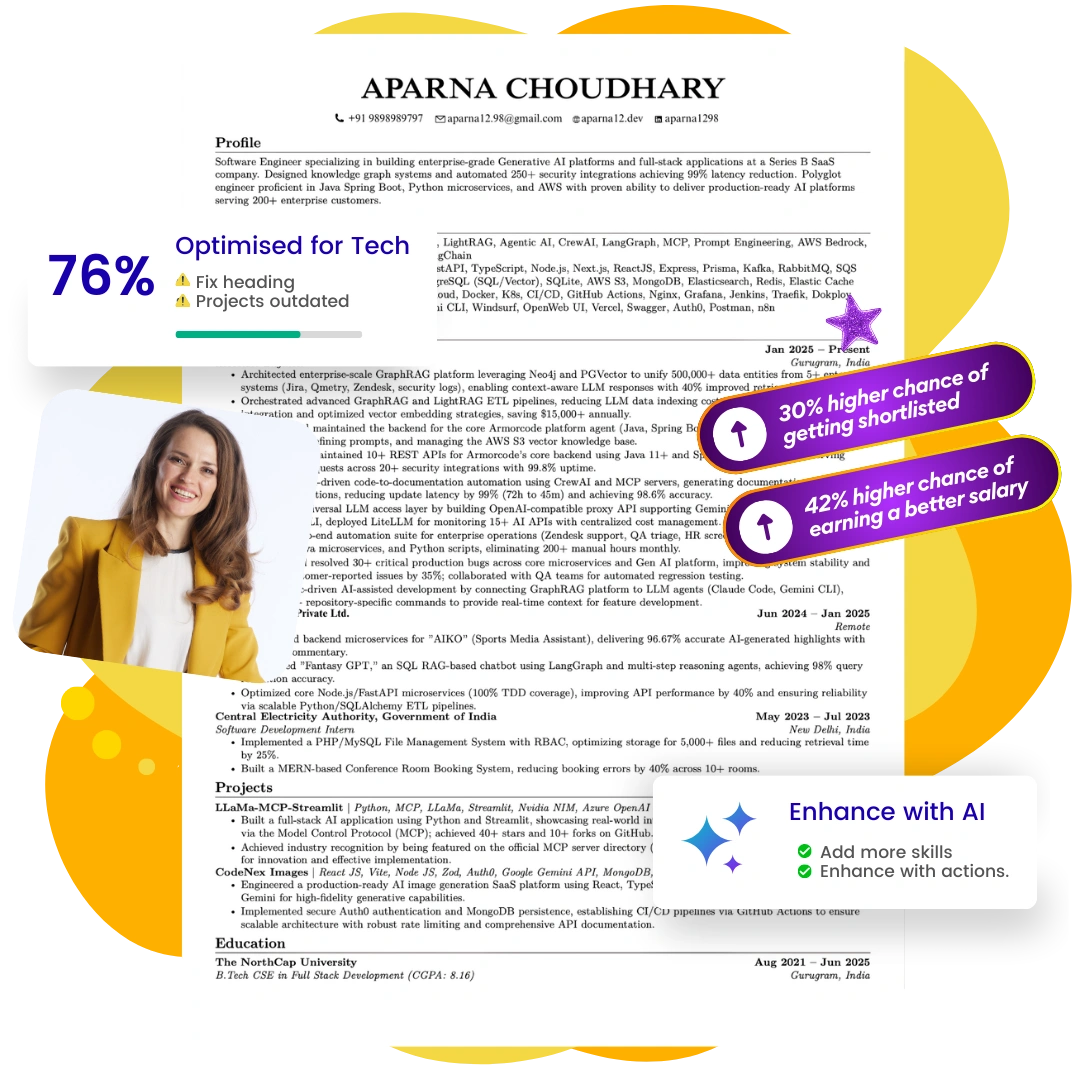
we create what industry demands

    Build a Professional Resume for your Tech career

    Increase your chances of landing an interview with a resume designed to navigate Applicant Tracking Systems seamlessly.


    Trusted By
    Amazon
    Adobe
    Accolite
    Accenture
    BandhanBank
    Bosch
    Capgemini
    Deutsche Telekom
    Eleven
    Free Online Resume Builder

    uniqueness

    Why We Chose This Resume Template for You?

    1000+

    Proven Success with 1000+ Students

    Trusted by top hires at Google, Microsoft, and Amazon; this resume template delivers the highest selection success

    500+

    Backed by Insights from 500+ HRs

    HRs at top companies confirm: this template is clear, structured, and boosts selection chances by up to 90%.
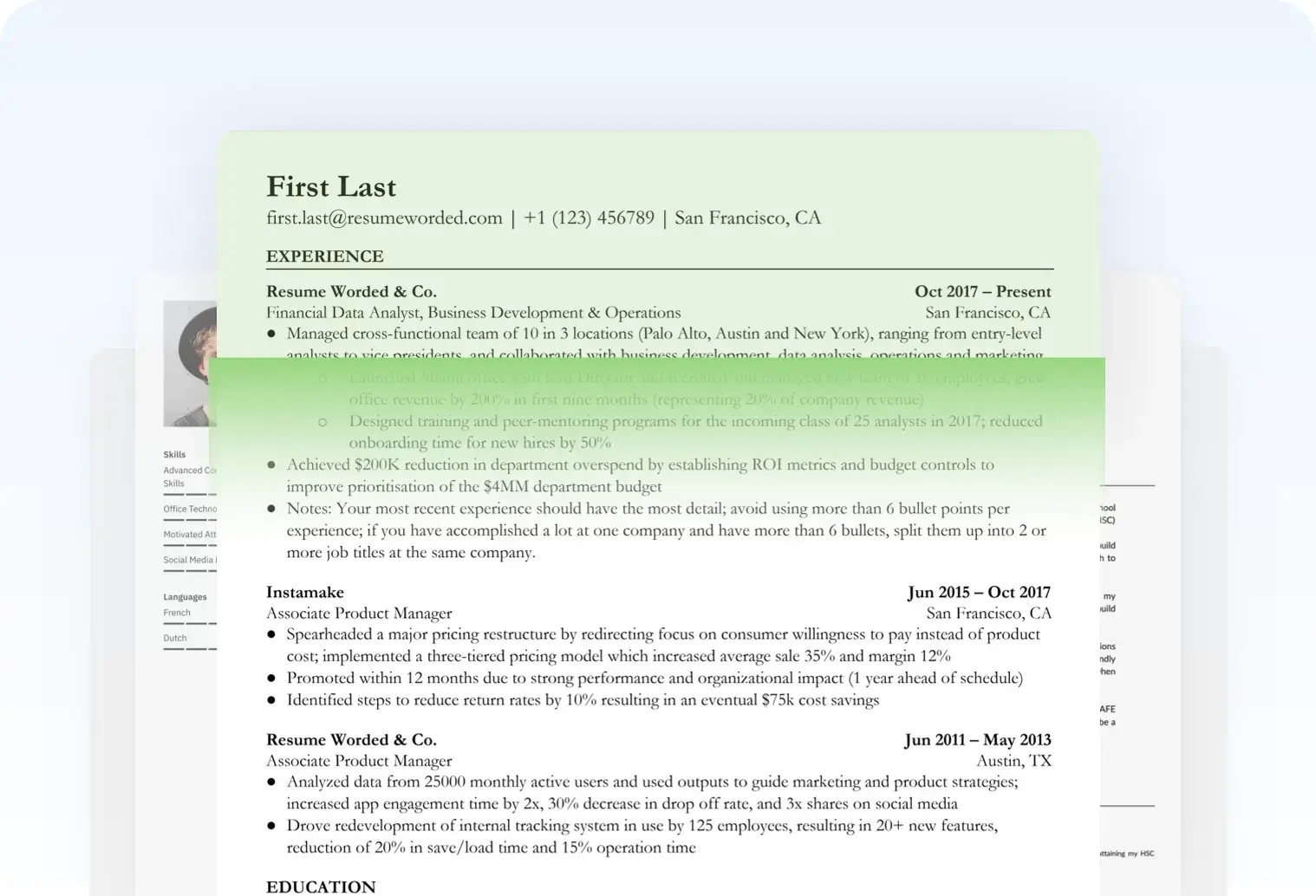
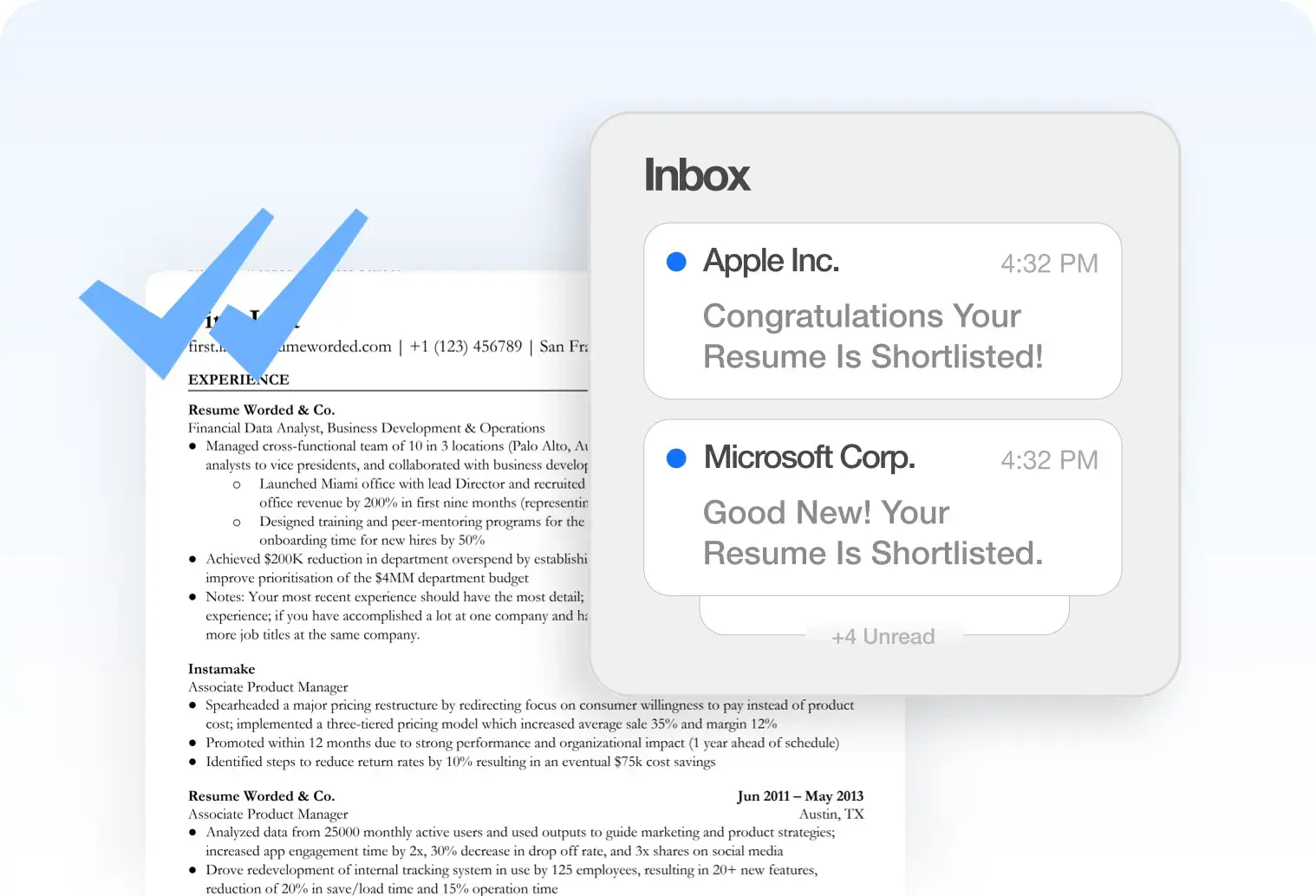
    Rise above the rest
    with ATS friendly resume template

    ATS friendly resume template

    ATS Resume Analysis Based on Tech Industry Standards!

    ATS Resume Analysis

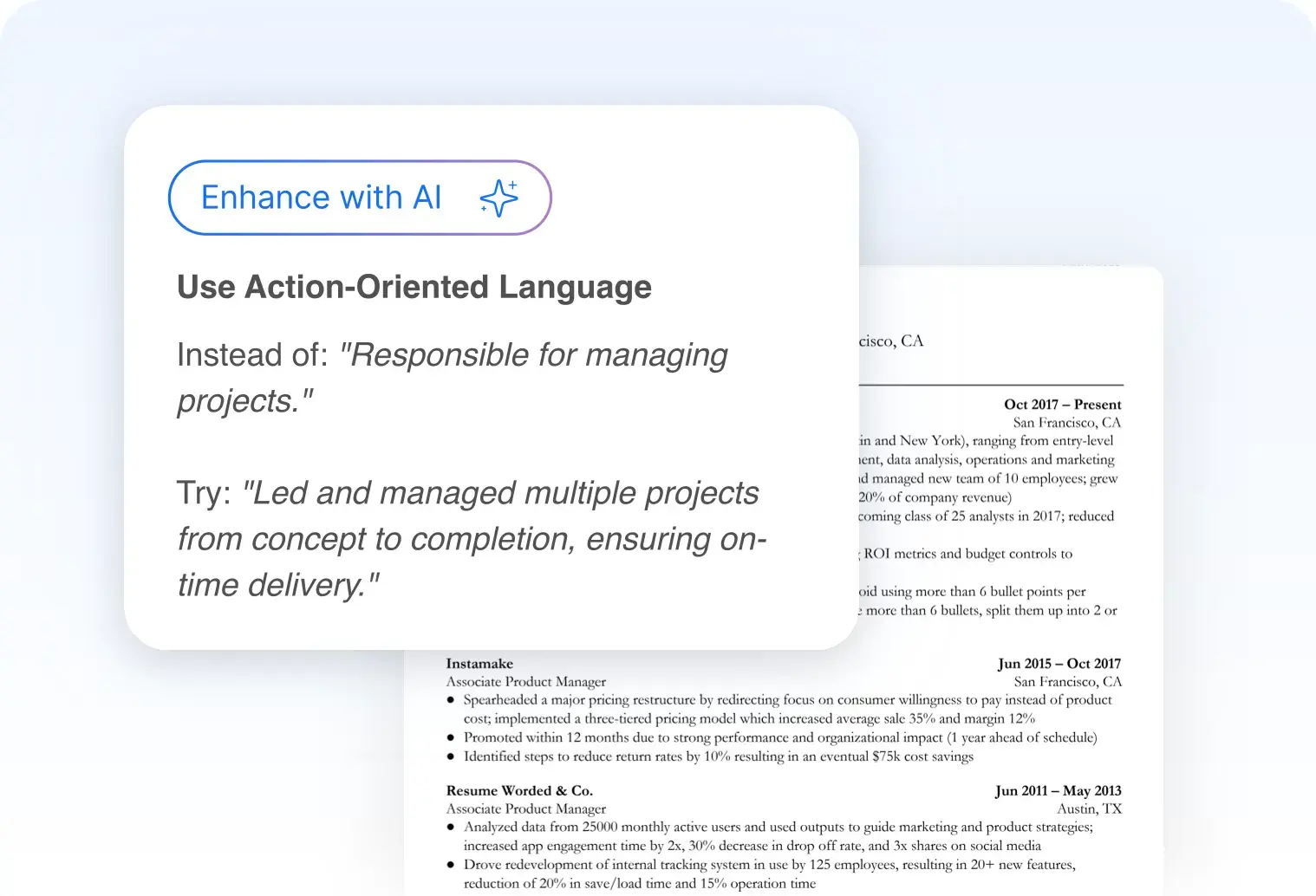
    AI-Powered Resume Suggestions Approved by Recruiters

    AI-Powered Resume Builder

    Frequently Asked Questions

    A resume is your 1-2 page marketing document that shows recruiters why they should interview you. For software engineers, it's not just listing jobs; it's showcasing impact with numbers ("reduced latency by 67%"), technologies you've actually used (React, AWS Lambda, not just "frontend"), and real problems you've solved. Think of it as your highlight reel, not your autobiography.

    Start with clean contact info (phone, email, LinkedIn, GitHub). List work experience newest to oldest, but don't just write what you did, write the impact with metrics. Add a skills section grouped by category (Frontend: React, Backend: Spring Boot). Include 2-3 solid projects if you're a fresher. Keep it 1 page for under 5 years experience. Most importantly: use action verbs (Built, Optimized, Reduced) and always add numbers.

    Reverse chronological works best: your latest job first. Use single-column layout (not fancy two-column designs that confuse ATS). Stick to standard fonts like Arial or Calibri, 10-12pt. Keep formatting simple: clear section headers, consistent bullets, proper spacing. Avoid tables, graphics, or creative designs. Our templates follow this exact format and parse perfectly in company ATS systems.

    One page for 0-5 years experience. Maximum 2 pages if you're 5+ years in. Here's why: recruiters spend 6 seconds on the first scan. If they can't find your best work in that time, you've lost. Focus on recent, relevant stuff. That college project from 2019? Cut it if you have 3 years of work experience now. Quality beats quantity every time.

    • Must-have: Contact info with LinkedIn/GitHub, Work Experience (with metrics, not responsibilities), Technical Skills (grouped; don't just dump 30 technologies), Projects (for freshers), and Education.
    • You can add: Certifications, Open Source work, Publications.
    • Skip these: Objective statements (waste of space), References (they'll ask if needed), Unrelated hobbies, Generic "team player" claims without proof.

    Your projects ARE your experience. Treat them like work experience: include tech stack, problems solved, and impact with numbers ("served 500+ users," "99.2% uptime," "GitHub: 200 stars"). Add internships (even if 2 months), bootcamp projects, open source contributions, hackathon wins. List relevant coursework only if it's directly useful (Data Structures, not Environmental Science). What matters: can you build stuff and show results? That's what recruiters want to see.

    In tech, always use "resume" (1-2 pages, focused on relevant work). CVs are academic documents (10+ pages, every publication, every conference). When applying to Google, Amazon, or any tech company in India or abroad, submit a resume unless they specifically ask for a CV. If you're unsure, go with resume; it's what tech recruiters expect.

    Use Coding Shuttle Free Online Resume Builder: completely free, no credit card needed, no "upgrade to premium" nonsense. You get AI-powered suggestions (turns "worked on features" into "built X using Y, achieving Z% improvement"), FAANG-tested templates, unlimited PDF/DOCX downloads, and real-time ATS checking. Built by ex-Amazon engineers who've reviewed 10,000+ resumes. Free forever, no catch.

    Tech resumes need specifics: exact technologies (not "database" but "PostgreSQL with indexing optimization"), measurable impact ("reduced API response from 2.3s to 340ms"), scale ("handling 1M+ requests/day"), and technical depth (how you solved it, not just what you built). You must include GitHub link; recruiters will check. Generic stuff like "developed features" or "worked in a team" gets you rejected instantly.

    No, that's a myth. FAANG uses ATS to store and search resumes: a human always reads it. However, bad formatting can mess up parsing (your name might appear under "Skills" instead of "Name"). To avoid this: use single-column layout, save as PDF, use standard section headers, no fancy graphics or tables. Our templates are tested with actual ATS systems at Google, Amazon, and Microsoft; they parse correctly every time.

    Every task has measurable impact; you just need to find it. Use these:

    • Performance: reduced time from X to Y
    • Scale: handled N users/requests
    • Business: increased conversion by X%
    • Time savings: decreased build time by Y%
    • Quality: reduced bugs by X%
    • Cost: saved ₹Y/month

    Don't have exact numbers? Estimate intelligently: "processed 10K+ daily API calls" or "served 500+ users." Our AI prompts walk you through this step-by-step.

    • For freshers and bootcamp grads: Absolutely yes; projects are your experience. Include 2-3 with real depth: tech stack, actual users, live demos, GitHub links.
    • For 3+ years experience: Only if the project is impressive (popular open source contribution, side project with real users, production app with metrics).

    Never include basic tutorial stuff like to-do lists or calculator apps in 2026; the bar is higher now.

    • For 0-5 years: include everything relevant.
    • For 5-10 years: focus on last 7-8 years, keep older stuff brief.
    • For 10+ years: highlight last 5-7 years, just one line for earlier roles unless super relevant.

    Exception: if you did something important 12 years ago that's directly relevant to this job, include it. But keep it max 2 pages total; even senior engineers shouldn't go beyond that.

    PDF is standard for 95% of tech companies including FAANG. It preserves formatting and looks professional across all devices. Name it properly: "Anuj_Sharma_Resume.pdf" (not "resume_final_version_3_updated.pdf"). Only use .docx if the job posting specifically asks for it. Our builder exports both clean PDFs and .docx files that are ATS-friendly.

    Yes, and it takes just 5-10 minutes. Tailoring increases callbacks by 40%+. Here's how: reorder your bullets to put most relevant stuff first, add keywords from job description (only if you actually have that skill), emphasize their tech stack, highlight related experience. With our free builder, just duplicate your resume, paste the job listing, and get AI suggestions on what to customize. Don't start from scratch every time; just tweak what matters.

    Clean and simple wins. Single-column layout, standard fonts (Arial, Calibri), clear section headers, scannable dates and companies. Zero fancy stuff: no graphics, no photos, no creative designs. Our Jake and Sofia templates are specifically tested with FAANG ATS systems (Google, Amazon, Microsoft) and follow the exact format that actually gets interviews. Choose based on your experience level, not how "cool" it looks.

    We built this after reviewing 10,000+ resumes and seeing the same mistakes everywhere. Our free builder gives you:

    • AI that transforms weak bullets into strong ones with metrics
    • FAANG-tested templates that parse correctly in company systems
    • Real-time prompts for adding impact and numbers
    • Tech-specific action verbs
    • ATS compatibility checking

    Unlike generic builders, we understand what "optimized queries" actually means. Built by ex-Amazon engineers. Zero cost forever.

    Yes, 100% free. No credit card, no "free trial then pay," no premium features locked away. You get everything: all templates, AI-powered suggestions, unlimited downloads (PDF + DOCX), ATS checking; completely free. Why? Because we're educators first. The more students from Coding Shuttle who land at top companies, the better our reputation. Simple as that. We're not building a SaaS company, we're helping students get jobs.

    Top 10 from reviewing 10,000+ resumes:

    • Zero metrics anywhere: just "worked on" statements
    • Listing 20+ technologies you barely know
    • Including college projects when you have 3 years work experience
    • Resume longer than 2 pages for mid-level roles
    • Buzzword-heavy with zero substance
    • Formatting that breaks ATS (tables, columns, graphics)
    • No GitHub link or empty profile
    • Unprofessional email (coolcoder123@yahoo)
    • Photo on resume (not needed in tech)
    • Copy-pasted job descriptions

    Our builder prevents all of these with built-in checks.

    Use this formula for every bullet: [Strong Verb] + [What You Built] + [Technologies] + [Measurable Impact].

    Example: "Reduced API response time from 2.3s to 340ms (85% improvement) by optimizing PostgreSQL queries with indexing and implementing Redis caching."

    Lead with your strongest achievements in the first 2-3 bullets; that's what recruiters see in the 6-second scan. Include technical depth (not just "improved performance" but HOW you improved it). Our AI builder helps transform your experience into this format automatically.

    Crack Top Software Jobs with Coding Shuttle

    Interested to know, how ?

    Connect on WhatsApp and we will handle the rest

    4000+ Students have transformed their career with our Premium courses

    Explore Courses

    Premium

    Structured Curriculum

    Experience expert-led learning with our industry-proven curriculum