Java HashMap
Introduction#
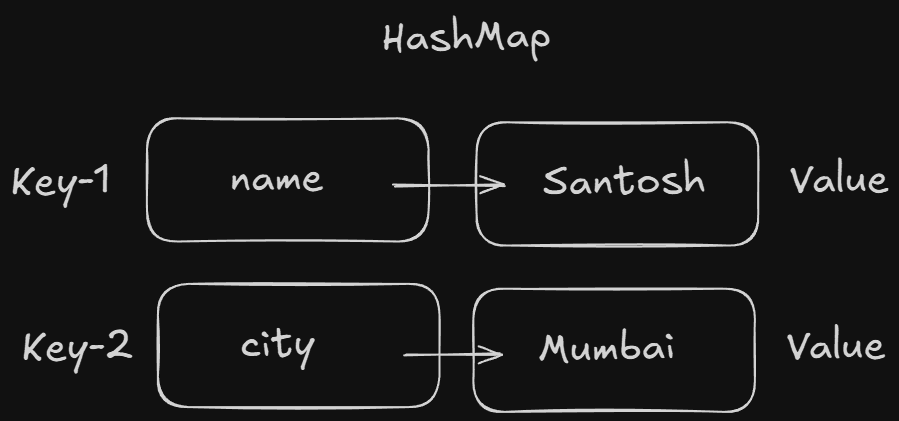
The HashMap class is one of the most commonly used data structures in Java, designed to store key-value pairs efficiently. It is a part of the java.util package and implements the Map interface.
This blog will guide you through everything you need to know about HashMap, including its working mechanism, key methods, examples, internal performance considerations, and a conclusion.
Key Characteristics#
- Implements the
Mapinterface. - Stores data as key-value pairs.
- Keys must be unique.
- Allows one
nullkey and multiplenullvalues. - Does not maintain any insertion or sorted order.
- Not synchronized (not thread-safe).
HashMap Syntax#
Example:
Commonly Used Methods in HashMap (With Examples and Output)#
1. put(K key, V value) – Add or update key-value pair#
Note:- Insertion order is not maintained here, To maintain insertion order use LinkedHashMap which we will see in our next blog.
Output:
2. get(Object key) – Retrieve value for a key#
Output:
3. remove(Object key) – Remove mapping by key#
Output:
4. containsKey(Object key) – Check if key exists#
Output:
5. containsValue(Object value) – Check if value exists#
Output:
6. size() – Total number of key-value pairs#
Output:
7. isEmpty() – Check if map is empty#
Output:
8. clear() – Remove all key-value pairs#
Output:
9. keySet() – Get all keys as a Set#
Output:
10. values() – Get all values as a Collection#
Output:
11. entrySet() – Get all key-value pairs as a Set of Map.Entry#
Output:
Example: Basic HashMap Usage#
Output:
Example: Iterating through HashMap#
Output:
Internal Working of HashMap#
- Internally, HashMap uses an array of Node objects (buckets).
- When you insert a key, it computes the hash code, which determines the bucket index.
- If multiple keys map to the same index (collision), the entries are stored in a linked list or balanced tree (Java 8+).
Performance and Time Complexity#
| Operation | Time Complexity |
|---|---|
| put() | O(1) average, O(n) worst (due to collisions) |
| get() | O(1) average, O(n) worst |
| remove() | O(1) average, O(n) worst |
Note: From Java 8, when a bucket has more than 8 entries, the linked list is replaced by a balanced tree, improving worst-case time complexity to O(log n).
When to Use HashMap#
- When you need fast lookup and insertion.
- When order of elements doesn’t matter.
- When you can ensure only one thread is accessing the map (or use
Collections.synchronizedMap()orConcurrentHashMap).
Conclusion#
In this blog, we explored the HashMap class in Java in detail. We covered how it stores data in key-value pairs, its key methods with examples and outputs, how it works internally, performance characteristics, and when to use it in real-world applications.
In the next blog, we will explore LinkedHashMap, which maintains the insertion order of key-value pairs while offering similar performance characteristics.