Docker Registry
Docker Registry is a centralized storage and distributed system for collecting and managing Docker images. It acts as a server-side application that stores, manages, and distributes container images across environments. It is an essential component in the containerization workflow for streamlining the deployment and management of applications. Features of a Docker Registry are:
- Stateless and scalable
- Organized into repositories, where each repository contains multiple versions (tags) of an image.
- Accessible to users for pushing (uploading) and pulling (downloading) images.
The default and largest public registry, hosting millions of official and community images is Docker Hub.
Docker Registry Working#
A Docker Registry stores and distributes Docker images. Users can push images to the registry and pull them when needed.
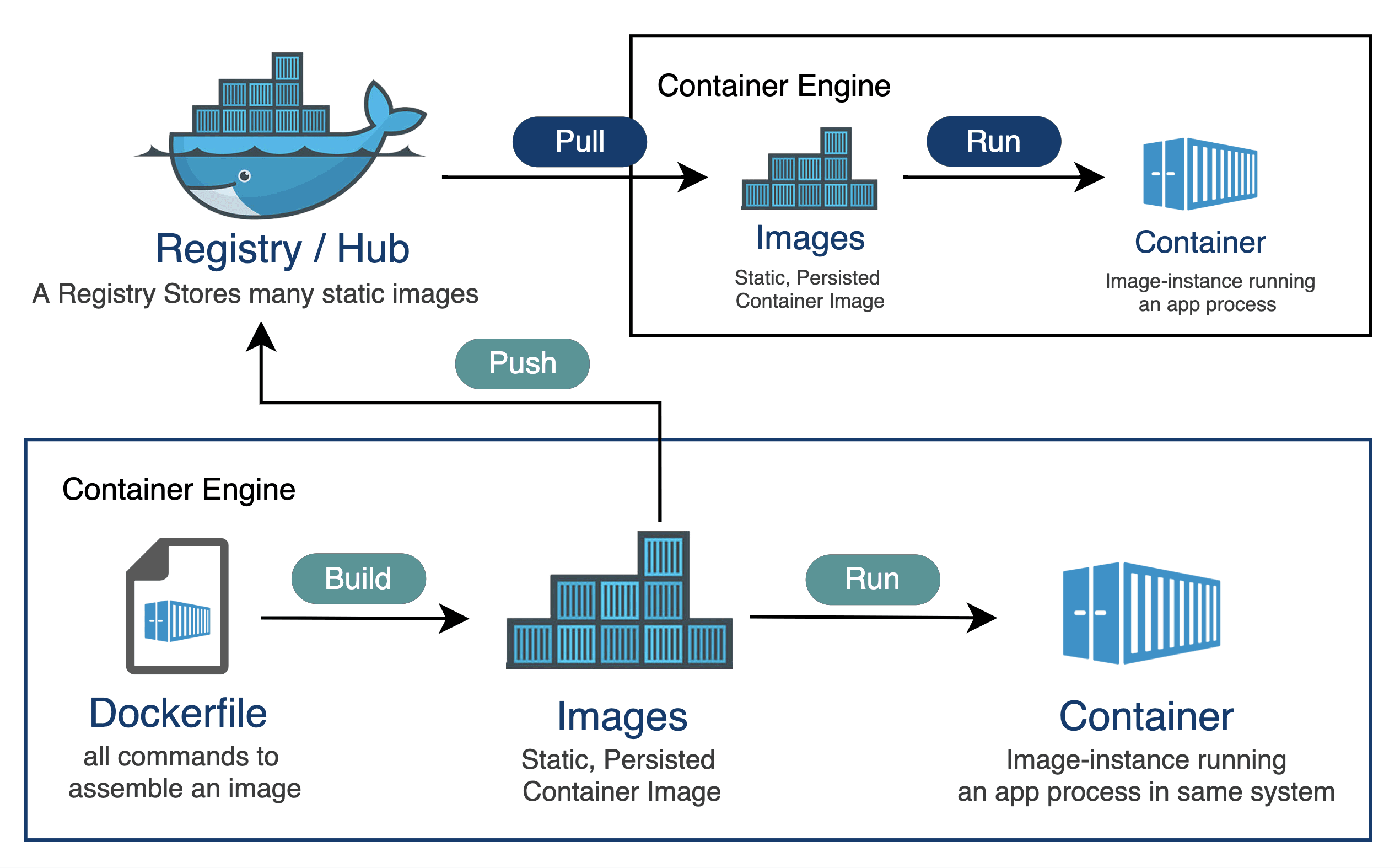
- A developer first builds a Docker image from a Dockerfile. The image is created locally on the Docker Host and consists of multiple read-only layers along with metadata and tags (such as
latestorv1.0). These layers represent each instruction defined in the Dockerfile. - If the target registry is private, the developer authenticates using
docker login. After authentication, the image is pushed to the registry usingdocker push. - The Docker Registry stores images in a structured manner using repositories and tags. Each image is saved as a set of content-addressable layers, meaning layers are identified by unique hashes. This prevents duplication and optimizes storage by reusing common layers across multiple images.
- On another system or environment (such as testing or production), the required image is retrieved using
docker pull. Docker compares the image layers available locally with those in the registry and downloads only the layers that are missing. - After the image is fully available on the target system, Docker can create and start a container using
docker run.
Conclusion#
Docker Registry plays a critical role in the container ecosystem by acting as a centralized and scalable storage system for Docker images. It enables seamless image distribution across development, testing, and production environments while optimizing storage through content-addressable layers and versioned repositories.