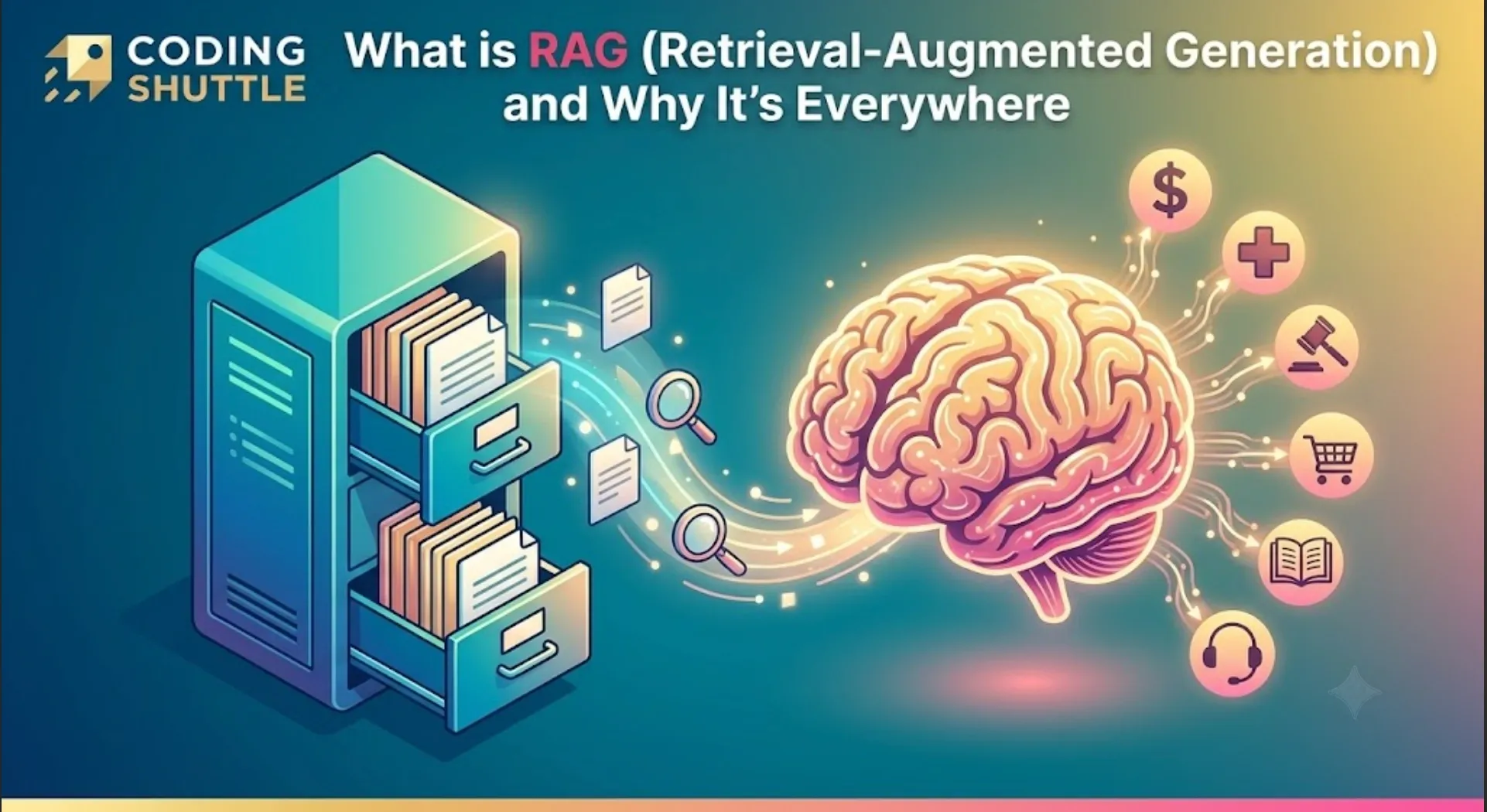
What is RAG (Retrieval-Augmented Generation) and Why It's Everywhere
Retrieval-augmented generation splits into an offline ingestion phase, where documents are chunked and embedded into a vector store, and a live query phase, where similar chunks are retrieved and handed to a model with the question. It covers retrieval quality, cost, and when RAG earns its complexity over plain chat.

Shreyash Gurav
August 29, 2026
5 min read
What is RAG (Retrieval-Augmented Generation) and Why It's Everywhere
A company builds a support chatbot on a frontier model. It answers general questions beautifully, then confidently invents a refund policy that does not exist. The model was never told the company's actual policies: they live in an internal wiki its training data never saw, updated last week. The bot is not broken. It is answering honestly from everything it knows, and everything it knows excludes you.
That failure mode, and the fix for it, explains why retrieval-augmented generation shows up in nearly every serious LLM deployment.
The Failure That Explains Everything#
Language models know two things: patterns from training data and whatever sits inside the current prompt. That is the entire input surface. When your application needs facts that are private, recent, or niche, only one of those surfaces can help, because retraining costs GPU-months and fine-tuning teaches style and behavior far better than it teaches perishable facts.
RAG takes the direct route: at question time, fetch the few relevant passages from your own data, paste them into the prompt, and instruct the model to answer using them. The model supplies language skill; your documents supply evidence. Nothing about the model changes.
How the Pieces Fit Together#
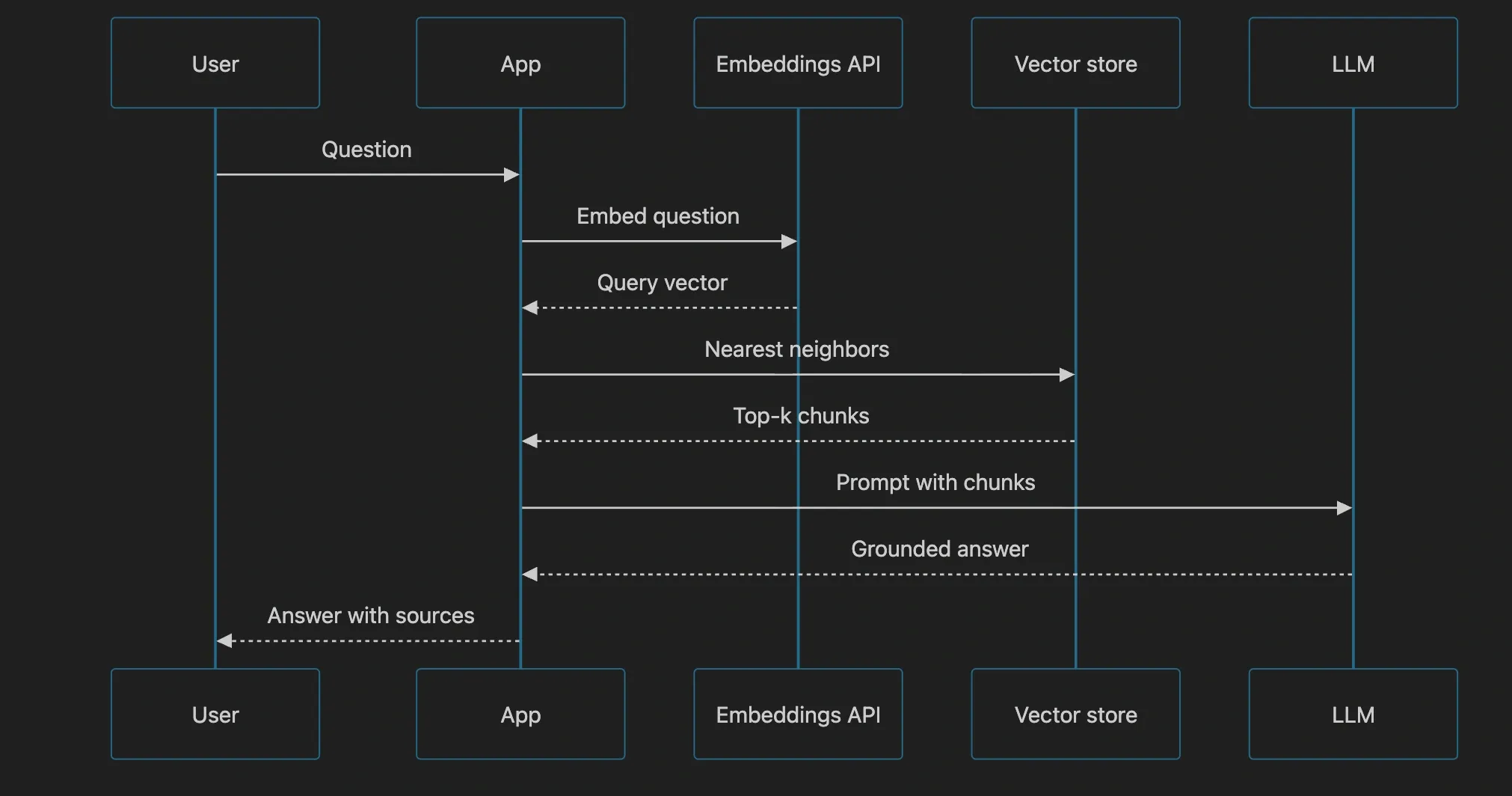
The architecture has two phases. Ingestion happens offline: documents are split into chunks, each chunk becomes an embedding vector via an embedding model, and vectors plus original text land in a vector store. Query time inverts it: embed the user's question, find the nearest stored chunks by similarity, assemble them into the prompt, generate.
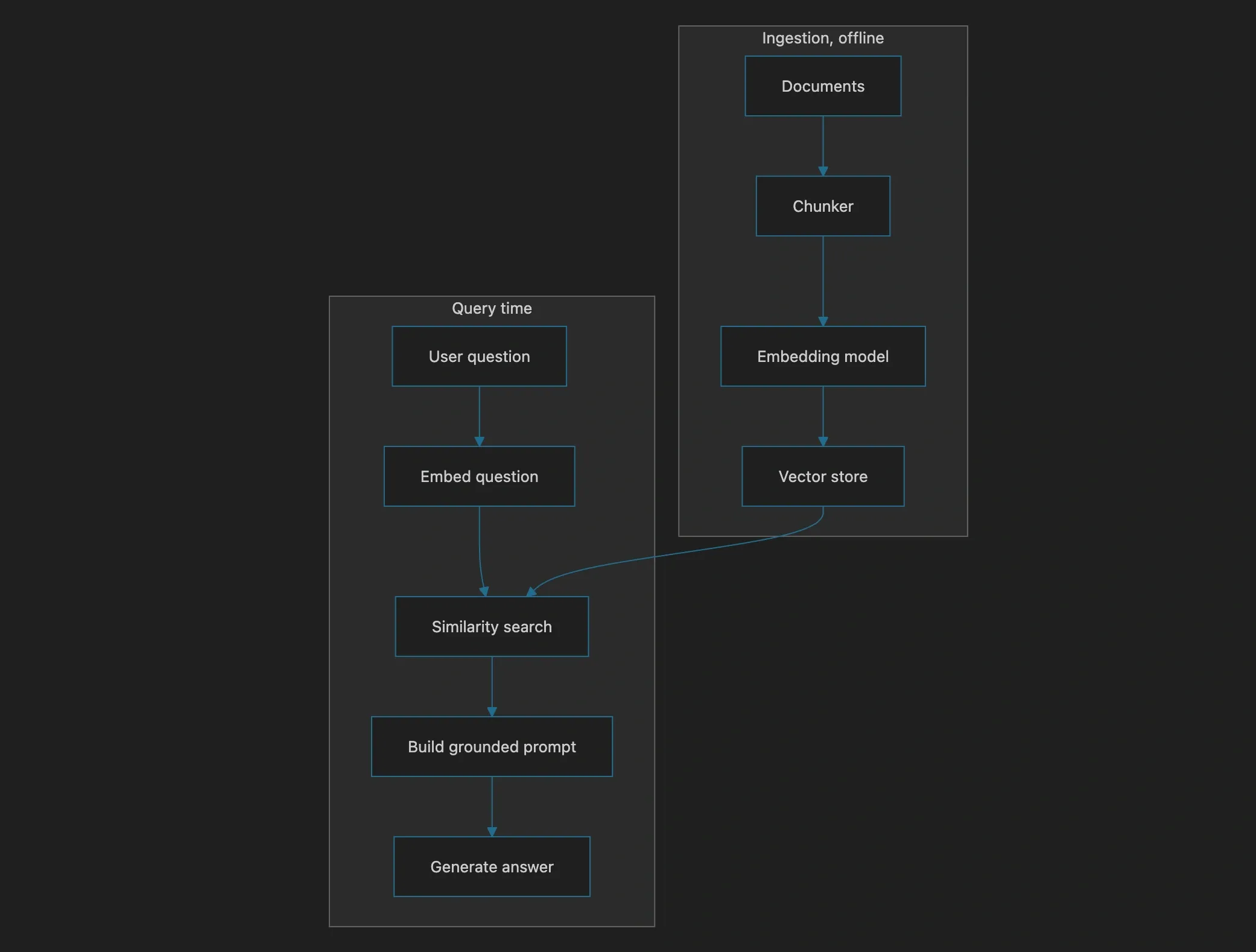
The chunking step deserves respect. Chunks too small lose context; chunks too large dilute the signal and eat window space. Splitting on natural boundaries like headings and paragraphs with a little overlap beats arbitrary character counts almost every time.
Minimal Working RAG, No Framework#
People expect RAG to be infrastructure. It is mostly a dictionary and some linear algebra until scale demands otherwise:
Read it slowly and notice what changed versus a plain chat call: retrieval replaced parametric memory with evidence, citations became possible because chunks carry source names, and the system instruction converts the model from improviser to reader. Those three moves account for most of RAG's reliability gains. Everything else in the ecosystem, including dedicated vector databases, rerankers, and frameworks, optimizes pieces of this loop.
Why It Beat Fine-Tuning for Knowledge#
For injecting facts, RAG outcompeted fine-tuning on four axes simultaneously. Updates: re-embed a changed document in seconds instead of scheduling a training run. Provenance: answers cite retrieved sources, which fine-tuned weights cannot do. Access control: filter what gets retrieved per user, something baked-in weights make impossible. Cost: embeddings are cheap; training runs are not.
Fine-tuning remains the right tool when the goal is behavior: consistent tone, strict output formats, domain jargon fluency. When the goal is knowledge, especially knowledge that changes, retrieval wins so decisively that arguing feels performative.
Where RAG Breaks#
Most production RAG failures happen before the model ever speaks. The pipeline retrieves badly, then the model faithfully reports garbage:
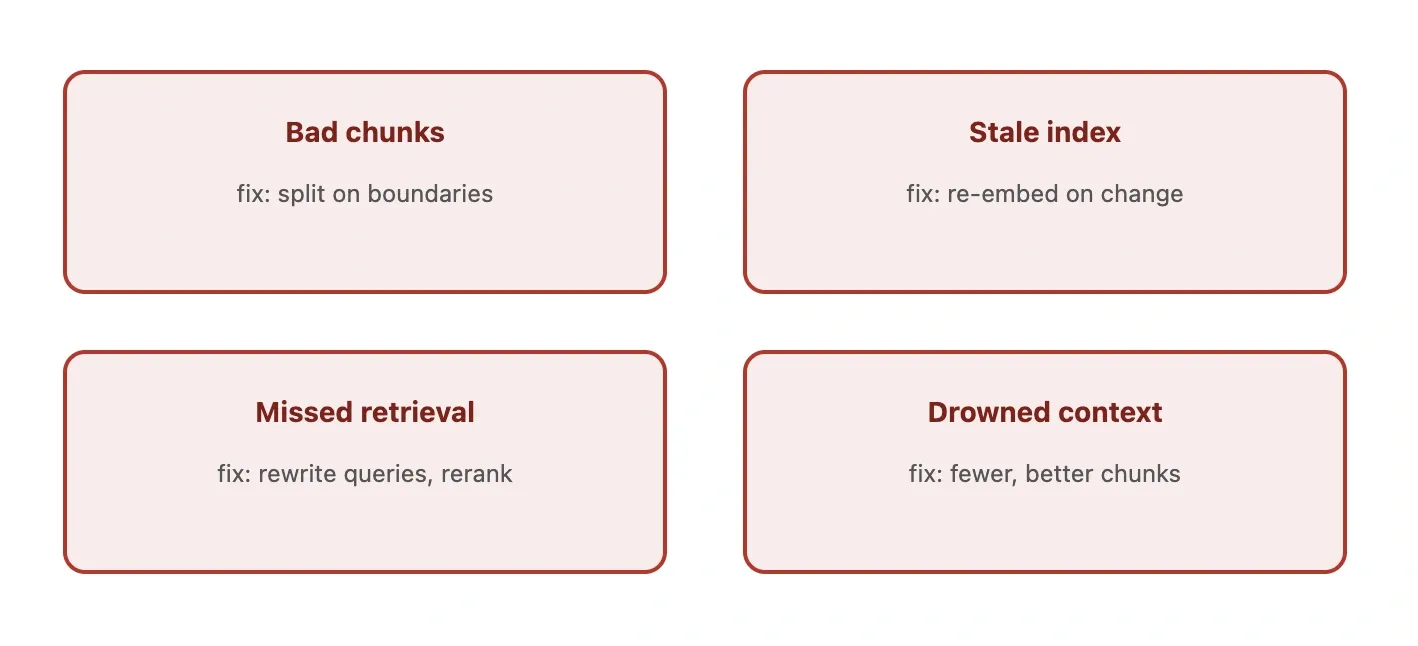
Two of these deserve emphasis. Missed retrieval is the silent killer: the user's phrasing shares no vocabulary with the document, similarity search shrugs, and the model either hallucinates around the gap or correctly says it does not know. Query rewriting and cross-encoder rerankers exist precisely for this. Drowned context reflects documented long-context behavior where models attend best to the start and end of long prompts, so ten mediocre chunks can hide the one relevant fact rather than surfacing it.
The engineering discipline that separates working RAG from demo RAG: evaluate retrieval separately from generation. Build fifty questions with known correct sources, measure how often search surfaces them, and only then tune prompts. Most "the model got it wrong" tickets resolve to "search returned nothing useful."
Why the Pattern Spread#
Every organization on earth has documents, and none of them have patience for retraining models whenever a policy changes. RAG turned "make the model know our stuff" from a machine-learning problem into a data-plumbing problem, which thousands of teams already know how to operate. It ships citations, respects permissions, updates instantly, and degrades gracefully by admitting ignorance. That combination is why the pattern is everywhere, and why learning to build this twenty-line loop well pays off across every codebase you will touch.
Want to Master Spring Boot and Land Your Dream Job?
Struggling with coding interviews? Learn Data Structures & Algorithms (DSA) with our expert-led course. Build strong problem-solving skills, write optimized code, and crack top tech interviews with ease
Learn more