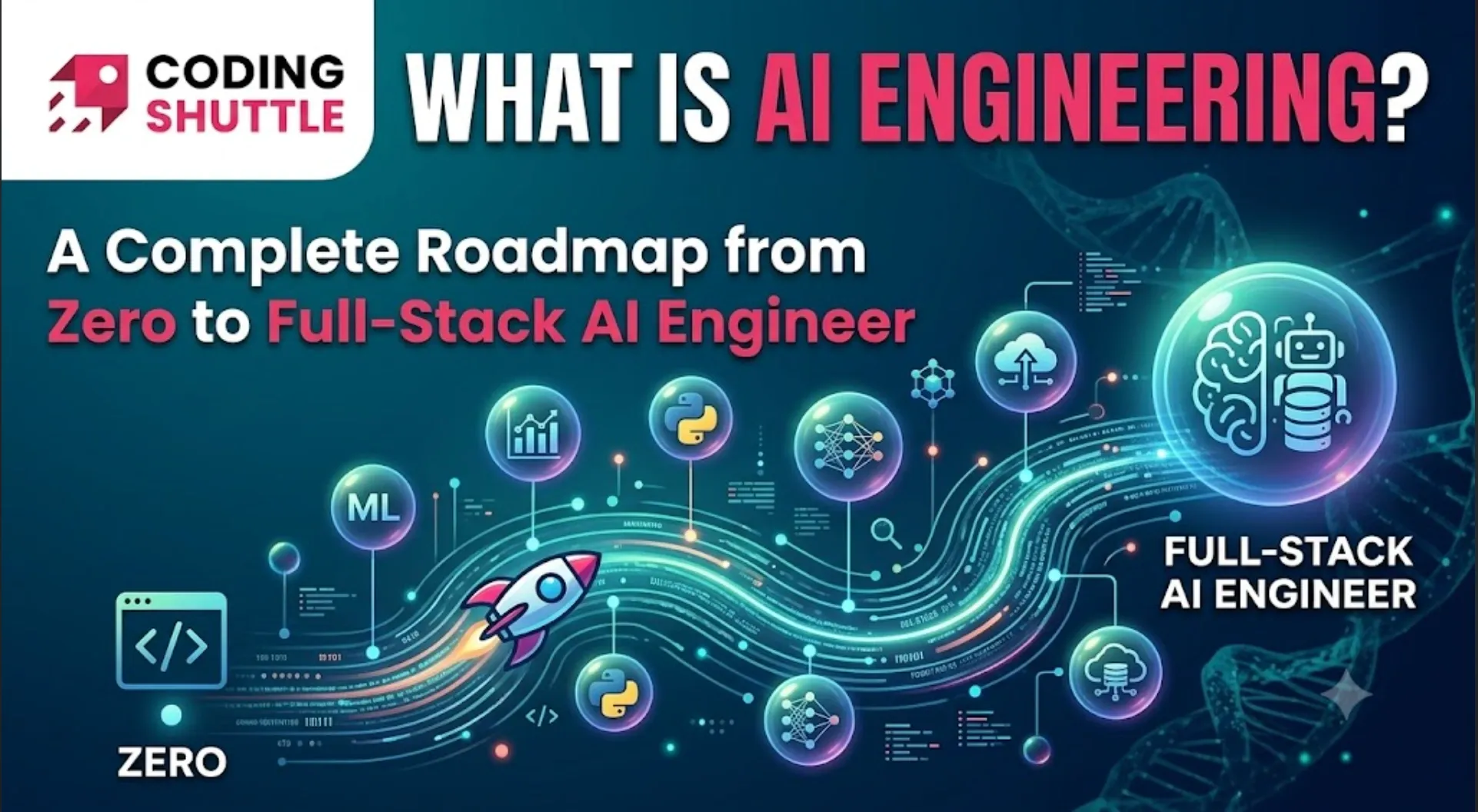
What is AI Engineering? A Complete Roadmap from Zero to Full-Stack AI Engineer
Stages chart the route from a first model call to a deployed, monitored system, sequencing compose, evaluate, and ship in order. It maps model choice, retrieval, and evaluation decisions, then adds the operational baseline most courses omit. A practical itinerary for turning a prototype into a product.

Shreyash Gurav
August 29, 2026
6 min read
What is AI Engineering? A Complete Roadmap from Zero to Full-Stack AI Engineer
Ask five companies what an AI engineer does and you will get six answers. Strip away the noise and the job is concrete: an AI engineer builds software products on top of pretrained models. You are not training models from scratch and you are not publishing research. You are integrating, orchestrating, evaluating, and shipping systems where a large language model sits at the center.
That sounds small until you look at what surrounds the model in any real product. The model call itself is maybe ten percent of the system. The other ninety percent is ordinary software engineering wrapped around a probabilistic component that is brilliant on some inputs, confidently wrong on others, priced per token, and slower than your database.
What the Job Actually Is#
Day to day, the work breaks into a handful of recurring responsibilities:
- Talking to model APIs and handling their failures gracefully
- Designing prompts and output schemas so responses are predictable enough to parse
- Building retrieval over private data the model has never seen
- Giving models tools: search, calculators, internal APIs, code execution
- Measuring output quality continuously instead of eyeballing it
- Managing cost and latency before finance or users manage them for you
- Deploying and monitoring the whole thing like any other service
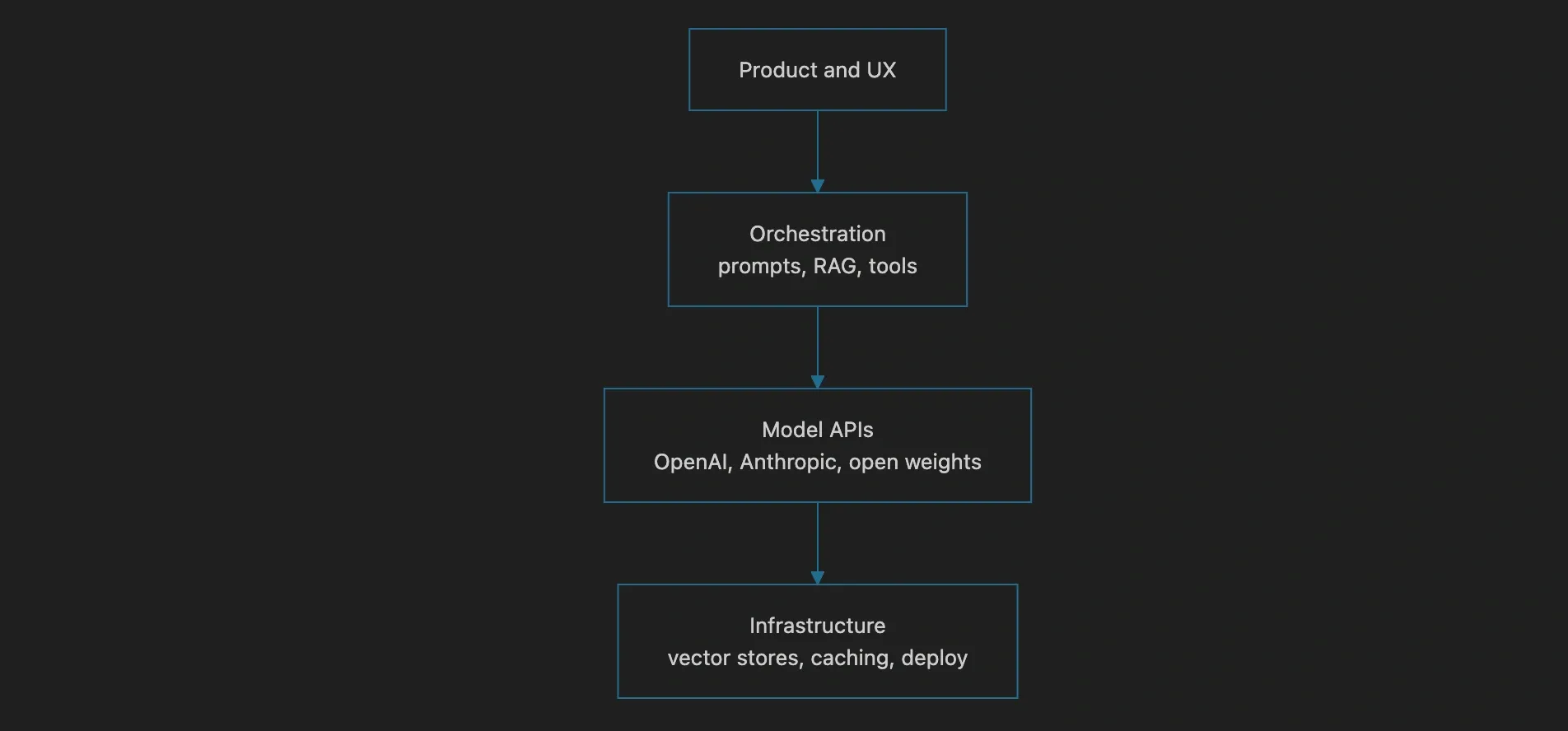
A useful mental model is a stack of four layers. The product layer owns UX and business logic. The orchestration layer is where AI engineers spend most of their lives: prompts, retrieval, tools, schemas. The model layer is rented intelligence from OpenAI, Anthropic, or open weights. The infrastructure layer keeps everything observable, cached, and deployed.
How This Differs From ML Engineering#
ML engineers train and fine-tune models and own data pipelines and serving stacks; AI engineers compose pretrained models into products. That is the short version of the distinction. The consequence for this roadmap is what matters: because this role is about integration, the sequence below weights composition, evaluation, and shipping far more heavily than model training.
How to Sequence Your Learning#
The stage order in the next section matters, but the sequencing between stages has its own rules, and self-directed learners trip on three of them.
First, finish a stage enough to be dangerous, not enough to claim mastery. The goal at each stage is to complete one working thing, not to read everything about it. Second, carry a single live project across multiple stages instead of starting a fresh tutorial for each. One real task that you progressively harden is what makes the ordering feel motivated; without that project, each stage is abstract homework. Third, plan to revisit earlier stages once you have production instincts. Someone who studies prompting for weeks, builds one retrieval system, and then circles back to prompting understands the same techniques far better the second time, because they now know exactly what goes wrong.
The Roadmap, Stage by Stage#
The order matters because each stage unlocks the next. Skipping ahead mostly produces confusion that looks like bad luck.
Stage 0: Software foundations. Python fluency (not mastery), Git, HTTP, JSON, basic SQL, comfort in a terminal. If you can build a CRUD API, you are ready to move on. Do not spend six months "finishing Python" first; that is procrastination wearing a productive costume.
Stage 1: Talk to models. Learn both major SDKs, streaming responses, structured output, system prompts, token counting, and error handling around rate limits. This is the entire job in miniature:
Ten lines in, you are doing the core work of the role.
Stage 2: Prompts plus measurement. Learn the three core prompting techniques: zero-shot (clear instructions, no examples), few-shot (showing worked examples), and chain-of-thought (asking for explicit reasoning before answers). Then learn the part everyone skips: evaluation. Build a golden set of thirty input-output pairs before you get clever. Without it, every prompt change is vibes.
Stage 3: Retrieval-augmented generation. Models only know their training data. RAG fixes that: split documents into chunks, convert them to embeddings (numeric vectors capturing meaning), store them in a vector database, and fetch the few relevant chunks per query so the model answers from evidence instead of memory. Chunking strategy, embedding choice, and reranking all matter here. Most enterprise value in this field lives at this stage.
Stage 4: Tools and agents. Function calling lets the model request that your code run something and hand back results. Agent loops let it decide which actions to take across multiple steps. Protocols like Anthropic's Model Context Protocol standardize how tools plug in. Healthy skepticism required: most production wins are a single well-schematized call plus retrieval. Agents are powerful and fragile; earn them last.
Stage 5: Production. Observability per call (latency, tokens, cost), semantic caching, guardrails against bad outputs, fallbacks across providers when one is down, and graceful degradation when the model is uncertain.

Tools Worth Learning (and Skipping)#
Learn deeply: Python, Postgres (pgvector covers most vector-search needs), Docker basics, one cloud provider, both major SDKs, and a basic eval harness.
Skip for now: Kubernetes, CUDA, distributed training frameworks. They belong to ML engineering and infrastructure roles, and learning them before Stage 1 is a classic way to never reach Stage 1.
Frameworks like LangChain and LlamaIndex? Use them after you can do things with raw SDK calls. Abstractions are pleasant until something breaks, and things break constantly. Engineers who learned the raw API debug in minutes what framework-only engineers debug in days.
Where the Time Actually Goes#
Newcomers assume the job is writing clever prompts. In practice the split looks more like this, though it varies by team:
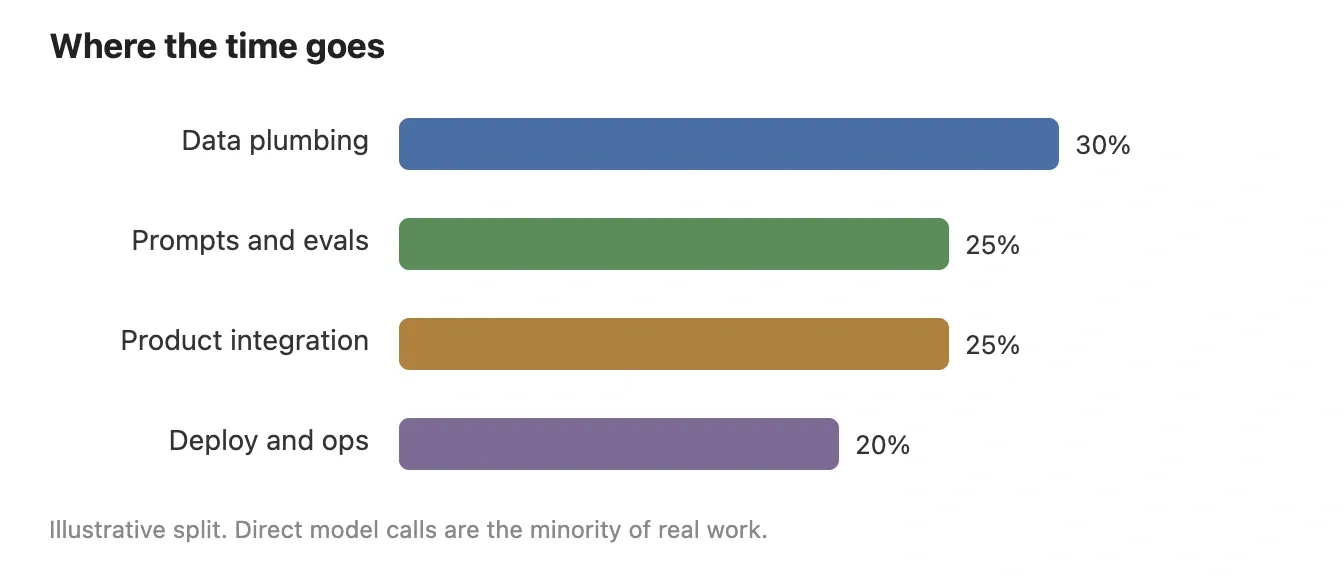
Notice what dominates: getting data into shape and verifying the model is actually correct. If that surprises you, good. It is the single most useful thing to know before choosing what to study.
A Way to Turn the Roadmap Into Day One#
Pick one repetitive text task from your own week: summarizing meeting notes, triaging messages, extracting fields from emails. Build it as a script with an SDK call, harden it with an output schema and retries, add a twenty-case evaluation set, then decide whether retrieval would improve it. That single project drags you through Stages 0 through 3 with a reason for every step.
The roadmap compresses dramatically when driven by a real problem. Shipping beats studying, and the engineer who has built five small things understands this field better than the one who has read fifty roadmaps.
Want to Master Spring Boot and Land Your Dream Job?
Struggling with coding interviews? Learn Data Structures & Algorithms (DSA) with our expert-led course. Build strong problem-solving skills, write optimized code, and crack top tech interviews with ease
Learn more