Vector Databases Compared: Pinecone, Chroma, Weaviate, Qdrant
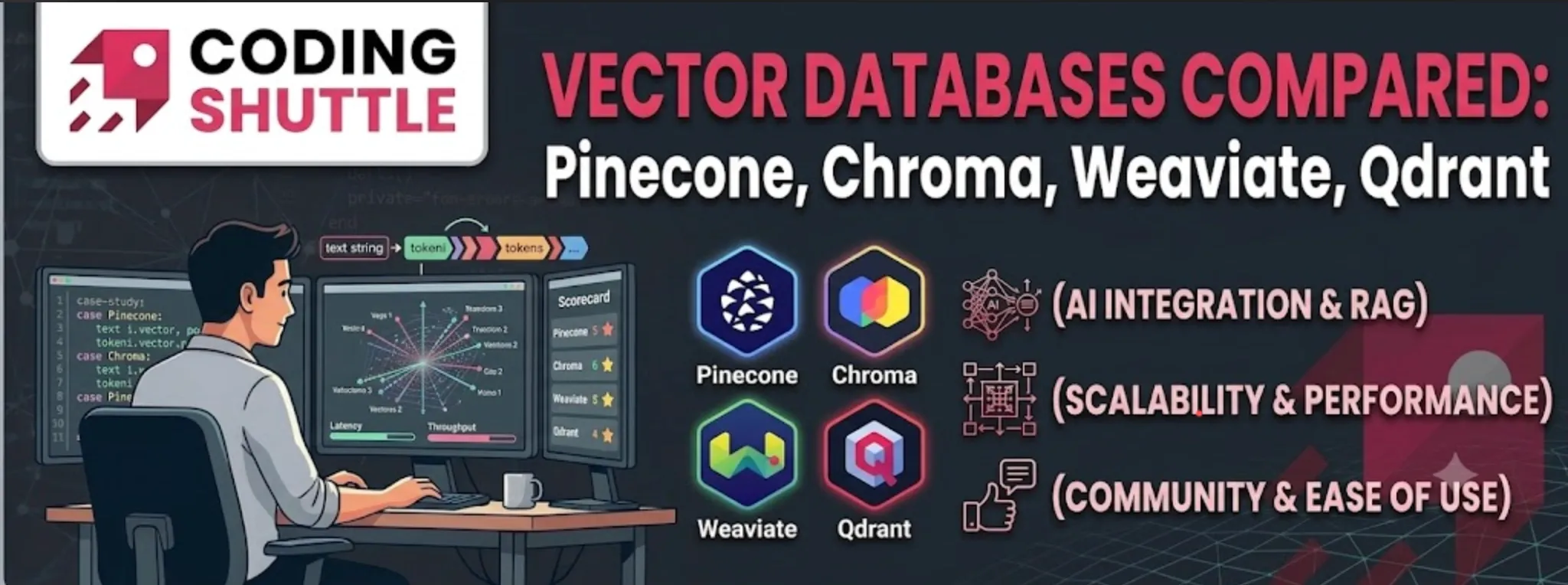
Pinecone, Chroma, Weaviate, and Qdrant are compared on deployment model rather than feature checklists, since managed versus self-hosted is the decision that actually shapes your architecture. The article shares their HNSW structure and the vocabulary of collections, upserts, and metadata filters. The most pragmatic vendor guide of the set.

Shreyash Gurav
August 29, 2026
5 min read
Vector Databases Compared: Pinecone, Chroma, Weaviate, Qdrant
Strip away the landing pages and these four products are siblings: store embeddings, attach metadata, filter on it, return nearest neighbors fast. The genuine differences live in deployment model, developer experience, and operational philosophy. Those differences matter more than feature-checklist deltas, so this comparison focuses there. One caveat up front: all four ship quickly and evolve monthly, so treat specifics as a snapshot and verify against current docs before committing budget.
The Vocabulary They All Share#
Every product here speaks the same conceptual language, which is why switching between them later is less painful than vendors imply. You create a collection (Weaviate calls it a class), you upsert vectors with an ID plus metadata payload, you query with a vector or text for top-k results, and you constrain results with metadata filters. Under the hood they all lean on approximate-nearest-neighbor indexing, HNSW most commonly, trading a little recall for orders-of-magnitude speed. Learning those five concepts once transfers everywhere.
Pinecone: Rent the Whole Problem#
Pinecone's pitch is that infrastructure is not your job and never will be. It is fully managed and serverless: no clusters to size, no index compaction to schedule, no failover drills. The API is thin and focused:
Strengths: the fastest zero-to-production path in the category, and it stays boring at scale, which is a compliment. Costs scale with usage rather than with foresight, data lives only in Pinecone's cloud, and tuning knobs are deliberately few. Teams with strict self-hosting requirements need not apply.
Chroma: The Developer's Notebook#
Chroma optimizes for the first five minutes. It installs with pip, runs embedded inside your Python process by default, and persists locally:
It even embeds documents for you with a bundled default model if you pass raw text, which makes prototypes nearly configuration-free. Strengths: unbeatable friction profile for experimentation, notebooks, and small production tools. Limits: it is not built for massive distributed deployments; teams do run it in production at modest scale via its client-server mode, but pushing it into Pinecone territory means swimming against its design.
Weaviate: Batteries Included#
Weaviate is the feature-dense one. Self-host it or use their cloud. Its distinguishing trait is doing more of the pipeline internally: modules can vectorize your data at ingest, hybrid search blending BM25 keyword scores with vector similarity ships out of the box, and queries arrive through a typed collections API:
Strengths: rich built-ins shrink surrounding code, especially hybrid retrieval, which competitors handle but with more assembly. Costs: more concepts to hold in your head, a heavier footprint when self-hosted, and module configuration adds surface area to learn before things click.
Qdrant: The Performance Pragmatist#
Qdrant is a Rust-core engine with a reputation for speed and disciplined resource usage. It runs as a single Docker container, scales horizontally, supports quantization to cut memory dramatically, and has arguably the strongest payload filtering story of the four, which matters enormously when real workloads combine "similar meaning" with "this tenant, this date range, this status":
Strengths: predictable performance, honest memory controls, Apache-licensed core, self-hosting that respects your time. Trade-offs: fewer built-in conveniences than Weaviate, smaller ecosystem gravity than Pinecone.
Positioning at a Glance#
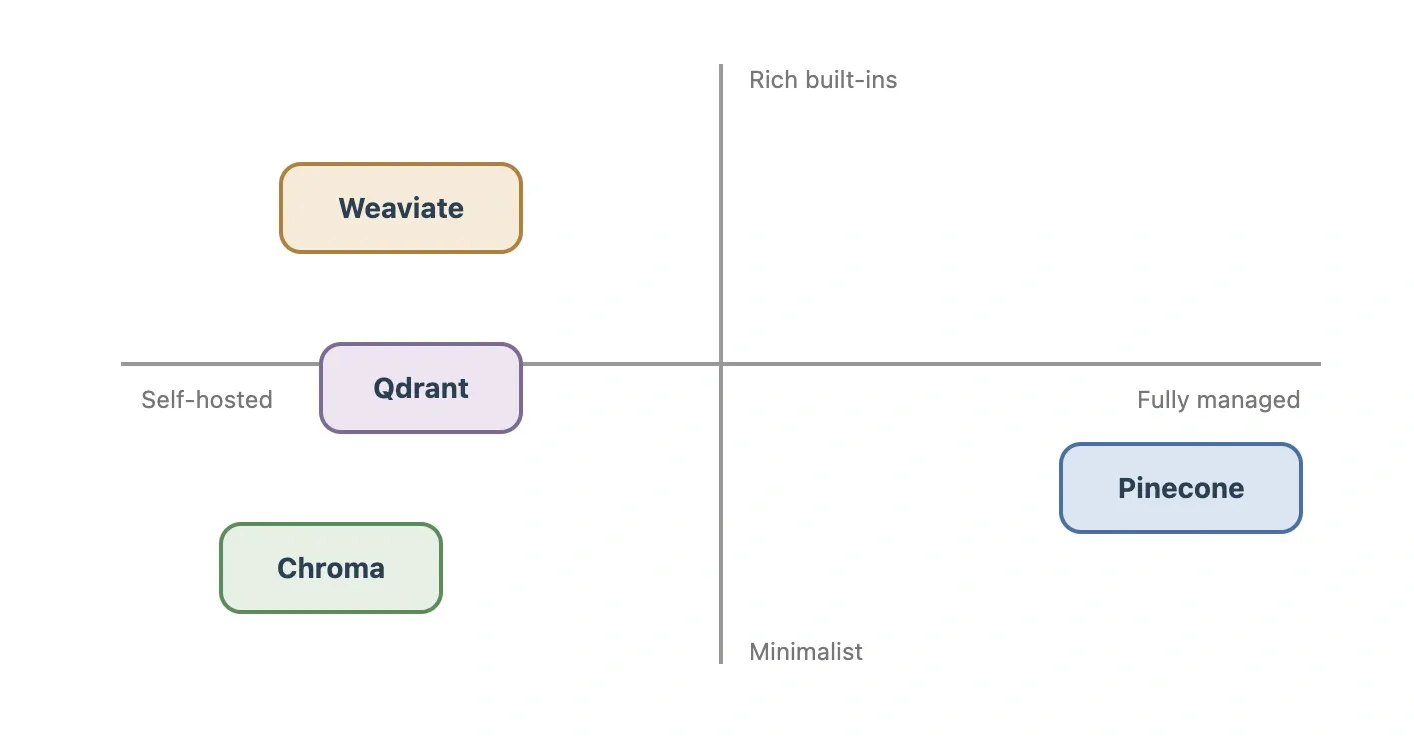
Map them by two axes that actually predict day-to-day satisfaction: how much operational burden lands on you, and how much functionality comes preassembled:
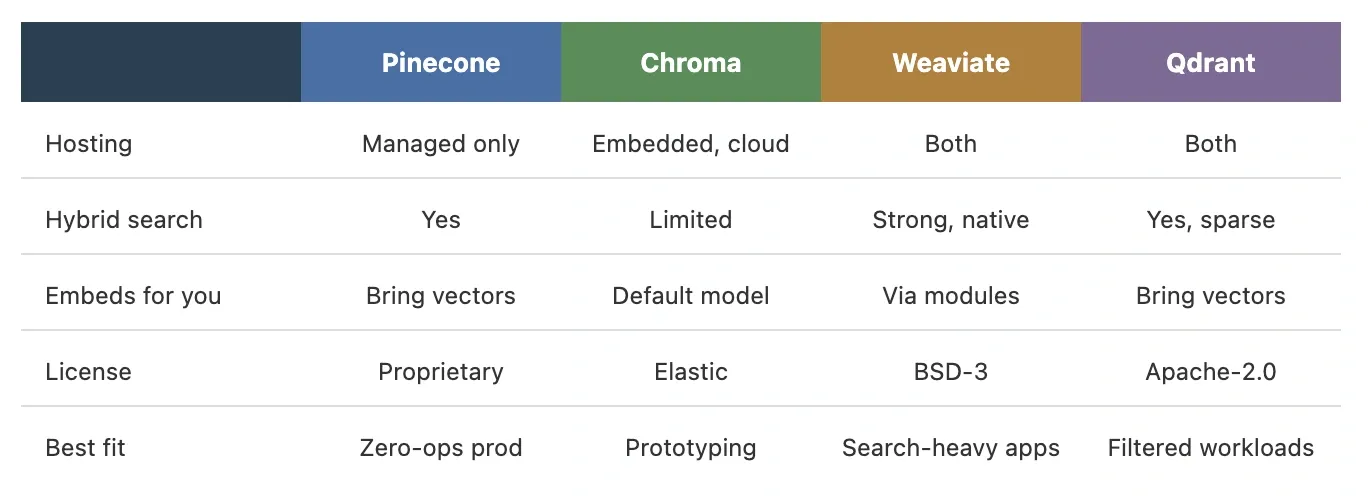
And the checklist view, useful for procurement conversations:
How I Would Choose#
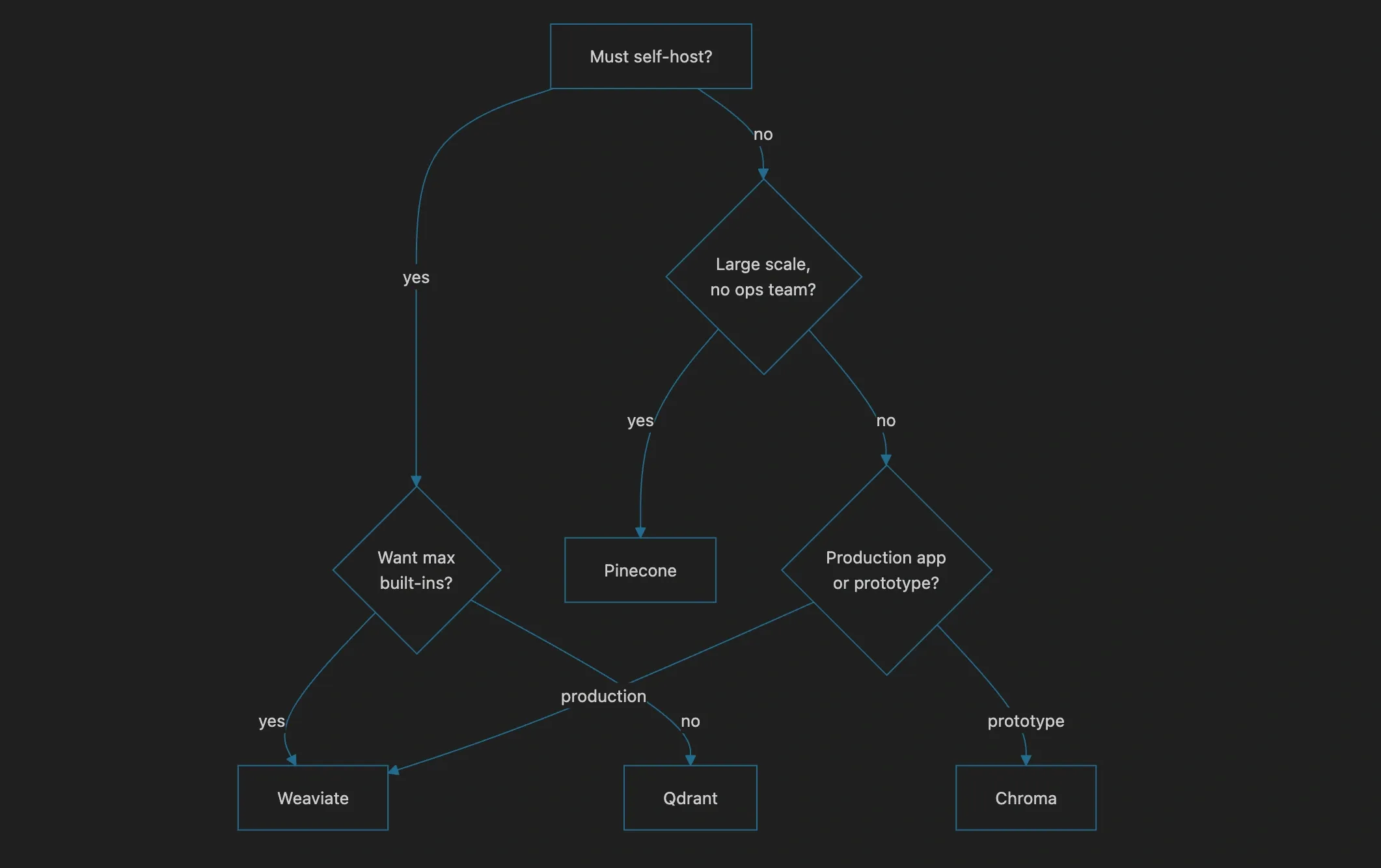
Prototype weekend, notebook-driven? Chroma, without hesitation. Startup shipping to customers with no appetite for infrastructure? Pinecone buys you months of not thinking about storage. Enterprise with compliance constraints, hybrid-search needs, and an ops team? Weaviate if you want maximal features per config file, Qdrant if latency predictability and filtering dominate. Performance-critical, cost-sensitive, self-hosted workloads with real engineers on call: Qdrant, comfortably.
One flow covers all of it:
Choose Fast, Migrate Cheap#
The uncomfortable truth about this whole comparison is that it matters less than the quality of your chunking, embedding choice, and evaluation set. All four return neighbors correctly; none will fix garbage ingestion. Pick by deployment constraint, keep every call behind a thin wrapper interface, and revisit after you have real traffic patterns. Migrating between these systems early costs a day. Agonizing over the choice costs a week, and the week never comes back.
Want to Master Spring Boot and Land Your Dream Job?
Struggling with coding interviews? Learn Data Structures & Algorithms (DSA) with our expert-led course. Build strong problem-solving skills, write optimized code, and crack top tech interviews with ease
Learn more