The Production AI Stack: The Layers Between Your Demo and a Real Product
The production AI stack organizes the pieces between a model and a shipped application into stable layers, from serving and retrieval to orchestration and evaluation. The article is a conceptual map rather than a tutorial, so teams can see where a problem belongs. Useful for architecture discussions.

Shreyash Gurav
August 29, 2026
10 min read
The Production AI Stack: The Layers Between Your Demo and a Real Product
Every team that ships a real AI product hits the same wall. The demo works, the notebook works, the single script works, and then the moment it has to run for actual users under real load, with actual failures, it quietly falls apart. A demo is a single optimistic path through a system; a product is a machine that has to handle every path, including the pessimistic ones your demo prompts never triggered.
The layers that sit between a demo and a product are the subject of this article: orchestration, memory, guardrails, observability, and deployment. Step back and you can see them as a map of the territory every production AI application crosses. This piece stays largely conceptual, walking through what each layer is, why it exists, how the layers relate, and the anti-patterns to watch for at each one. The position underneath: most teams underestimate how much of their engineering effort goes into these layers, and overestimate how much goes into the model.
The demo that lies to you#
A working demo, a notebook cell that returns a great answer, gives you exactly one data point: under this one input, with this one code path, against this one backend, this model produced text that looks right. That single point tells you nothing about the other inputs, convey the load, the failures, the concurrency, the observability, the security. A demo is the easy 10 percent, and it is easy precisely because it skips everything hard.
The truth is that the model, the thing you obsess over in the demo, is the most interchangeable and cheapest to replace part of a production system. The layers around it, the orchestration that retries and routes, the memory that persists across requests, the guardrails that decide what is allowed, the observability that tells you what broke, the deployment that survives a failure, these are where the engineering actually lives, and they are where two teams building the "same" product diverge wildly in quality.
So the right mental model: a production AI application is not an LLM with accessories. It is a distributed system in which an LLM happens to be the most interesting component. Treat it like one, and you will build something that survives. Treat it as a model plus some glue, and you will build something that works in the demo and dies in production.
Layer by layer: what a demo does not have#
Let me walk the stack as a diagram of layers, then go through each, because they each solve a specific failure that a demo simply never encounters.
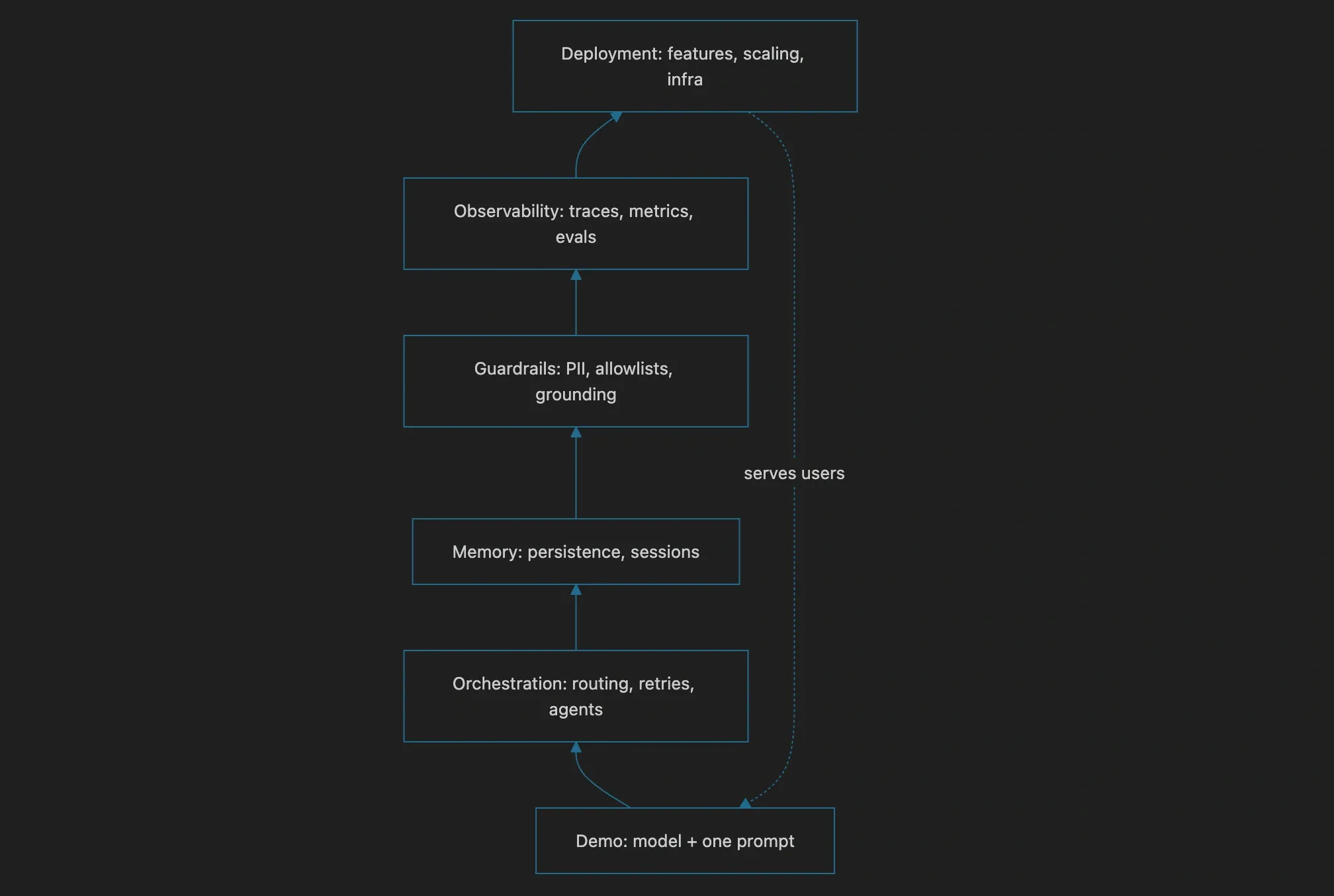
Orchestration is the first gap. Your demo calls the model once and prints. Production must decide which model to call for which request, retry when the provider rate-limits or times out, fall back to a cheaper model for simple traffic, maintain conversation state, and run the tool loop. The demo's linear script becomes a state machine, and the monotonic "works" becomes "works and recovers."
Memory and context, handled deliberately#
The second gap is memory. In the demo you have one conversation in one variable. Production has thousands of concurrent conversations, some lasting hours across sessions, and each one needs its history persisted and its context window managed. Users come back tomorrow, and their context has to be there.
This is where you stop storing every raw message and start being deliberate about what a session needs. A conversation that has 200 turns cannot all fit in context, and stuffing everything in is both slow and corrupting. So production memory usually separates two kinds of state: the durable record of what the user and agent said, stored in a database, and the compressed working context the model actually sees, often a rolling window plus a distilled summary of older turns.
Redis here is a decent persistence layer for conversation state because it handles many sessions with low latency and graceful scaling. But note what the code is doing: persisting raw turns, not the model's whole context. The production system must compress, and compression is a design decision, not an automatic benefit. Decide whether the model sees the last ten turns, whether older turns become a summary, whether tool outputs are retained in full or distilled, and test the impact of each choice on answer quality.
Guardrails are a layer, not a wish#
The third layer is guardrails, and I will keep this brief because it deserves its own treatment, but it must be in the stack or nothing else matters. Production means real users and real damage potential, PII leakage, destructive tool calls, hallucinated financial advice, and none of that is stopped by a nice prompt. The production posture is deny-by-default at the boundaries with authority, redact PII at input, verify grounding so the model only cites sources it was given, allowlist tools so the model can only cause damage you permitted, and escalate anything risky to a human.
The reason guardrails are a layer and not a prompt is that they are deterministic and structural. They do not ask the model to be good, they remove its ability to be bad past a boundary. That is the only way to ask a probabilistic system to enforce a hard rule, because you cannot trust the probabilistic part with the non-negotiable part.

Observability: the layer demo has none of#
The fourth gap is the one that surprises people most, because it is the least glamorous and the most essential. In the demo, you see the output, so you know it worked. In production, you see nothing, a user reports "it gave a weird answer" and you have no idea which of the dozens of steps, retrieval, model call, tool, guardrail, produced it. Without observability you are debugging blind, and "weird answer" is as much information as you will ever get.
The right tool is tracing. A single end-to-end trace per request, spanning the retrieval nodes, the model calls, the tool executions, the guardrail decisions, with timing and the actual inputs and outputs at each step. This is standard distributed tracing applied to an agent, and OpenTelemetry is the natural carrier.
The trace gives you the causal chain you need to answer the only question that matters when something goes wrong: "why?" Why was the retrieval empty? The trace shows the query and the retrieved count. Why did the guardrail reject it? The trace shows the decision. Why was it slow? The trace shows where the milliseconds went. Observability is not an afterthought to add when you have time; it is the thing that makes every other layer fixable, because you cannot fix a system you cannot see into.
Deployment and the brutal questions it forces#
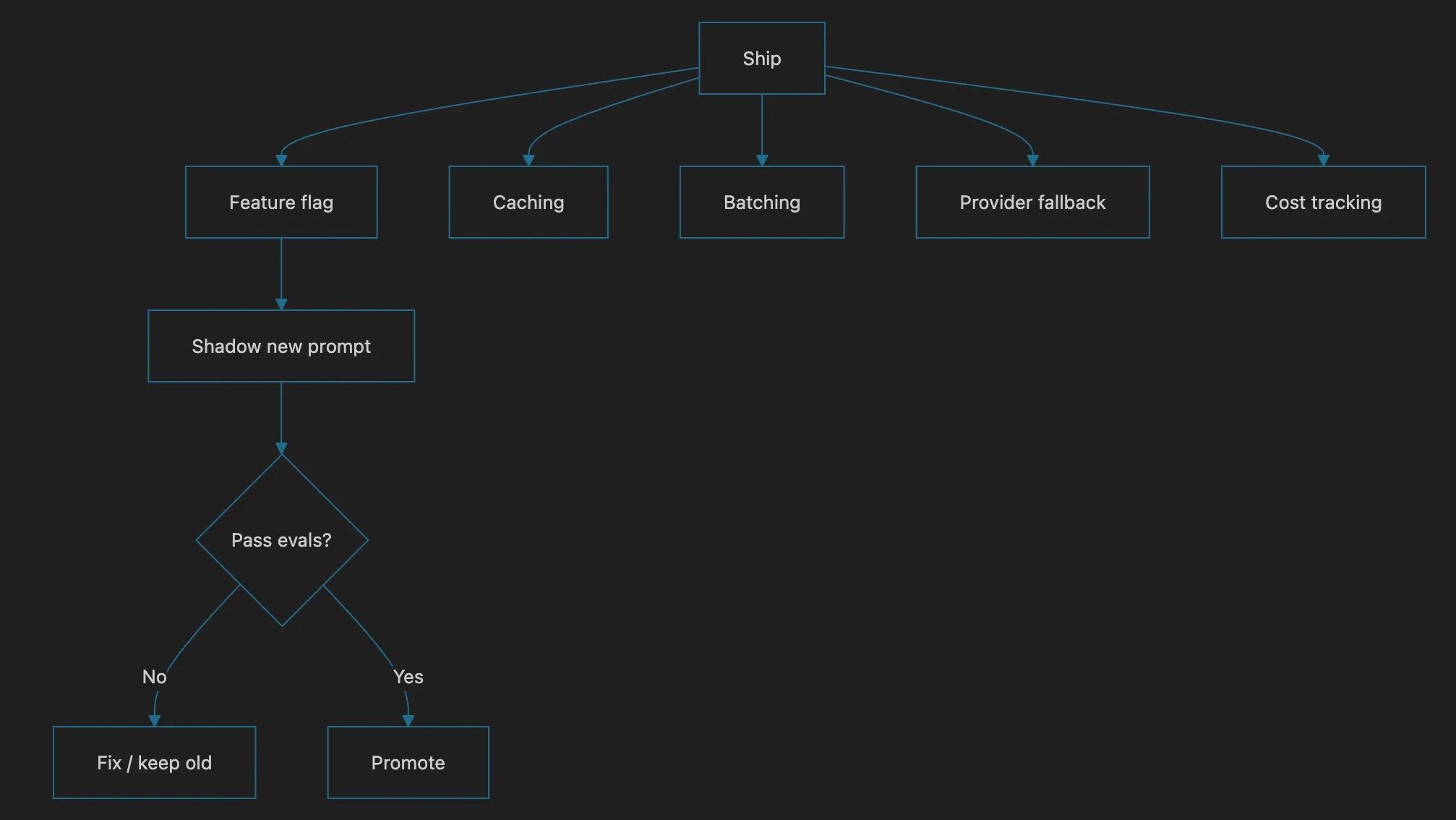
The final layer, deployment, is where a lot of the idealism dies, because it forces you to answer questions the demo never raised. How do you ship a change to the model or the prompt without breaking current users? The answer is feature flags and shadow traffic: you run the new prompt in parallel with the old one, compare their outputs with evals, and only promote the new one when it convincingly wins. This is not optional discipline; it is how you change a moving system without regressing it.
How do you scale as load grows? You need caching for repeated requests, which is a huge and underrated cost lever, and you need batching so you do not pay per-call latency and tokens unnecessarily. How do you survive a provider being down or degraded? You need fallbacks to other providers or models, and you need to have tested that fallback path before the outage, because testing it during an outage is when you discover it does not work.
Most brutally, deployment forces you to put a number on cost. A demo made one call. Production makes millions, and tokens are not free. The layer I have seen sink the most well-designed products is not engineering, it is the model bill. So cost is a production concern from the first day, not a surprise at the end of the quarter, and it shapes real decisions like which model for which tier of request, how aggressively to cache, and how long to keep history.
Caching deserves special attention because it is the cheapest cost lever most teams never pull. A large share of production traffic is repetitive, the same question phrased slightly differently, the same document re-summarized, the same classification done over and over. A simple content-addressable cache, keyed on an embedding of the request, turns the most expensive repeated path (model call, tokens, latency) into a dictionary lookup, because a cache hit costs a few milliseconds and a few bytes of network instead of a full inference.
The subtlety is that caching only helps with genuinely deterministic, safe responses, and you must be careful not to cache anything user-specific or time-sensitive. Caching a personalized support answer and serving it to the wrong user is a data leak disguised as a performance win. The discipline is to cache only when the response is a pure function of the inputs, in which case identical inputs deserve identical responses, and to keep personally identifying content out of cache keys entirely.

The inversion that matters#
Here is the position worth taking, and it is counter to the hype. The model is the part of your AI product you should spend the least engineering energy on, after you have picked a competent one, and the layers are where the real, differentiating work lives. Two teams using the same model, the same prompt even, build wildly different products, because one bolted a model onto a script and the other built a system with memory, guardrails, observability, and disciplined deployment around the model. The users of the second team's product know the difference even if they cannot articulate it.
So when you look at your working demo and feel the pressure to "productize it," do not reach for a fancier model. Reach for the stack. Add the orchestrator that recovers from failures, the memory that survives sessions, the guardrails that make unsafe actions impossible, the tracing that lets you see inside, and the deployment discipline that lets you change without breaking. Those layers are unglamorous, expensive, and tedious, and they are exactly why some AI products ship and work and why others demo well and die. The demo is you asking the model a question. The product is the machine that answers that question for everyone, everywhere, reliably, and it is a lot more than a model.
Want to Master Spring Boot and Land Your Dream Job?
Struggling with coding interviews? Learn Data Structures & Algorithms (DSA) with our expert-led course. Build strong problem-solving skills, write optimized code, and crack top tech interviews with ease
Learn more