Structural Reasoning in Agentic AI: Why Longer Context Isn't Enough
Attention dilution means models trust the nearest tokens while middle-of-context information fades, a real constraint on long agent tasks. The article covers structural fixes like GraphRAG and typed metadata that give the model retrievable structure instead of raw text. Aimed at reasoning reliability at scale.

Shreyash Gurav
August 29, 2026
11 min read
Structural Reasoning in Agentic AI: Why Longer Context Isn't Enough
Watch an agent fail on a question it nearly answers. It retrieves forty chapters, dumps them into a large context window, and still cites the wrong section or connects the wrong two facts. The natural instinct is to blame the context window and reach for a bigger one: buy more room, paste in the whole codebase or document, and let the model figure it out. Vendors encourage this, since bigger windows sell tokens. But the agents that reliably reason across many pieces of information are not served by a bigger pile of tokens. They are served by structure: explicit links, schemas, typed fields, and a plan that tells the model where to look and what to connect. Call it structural reasoning. The claim is specific: for a large class of agentic tasks, adding context makes the model worse, and adding structure makes it better.
I want to convince you of that with mechanics, not vibes, and then show you the concrete structural tools that actually move the needle: chunked retrieval with links, typed metadata, and graph-structured knowledge.
Why raw context degrades before it helps#
Everyone has felt the intuition that too much context is bad, but few understand the mechanism, so complaints stay vague, "the model got confused." The mechanism is attention dilution. A transformer's attention is a weighted mixture over all tokens in the window. As you add more tokens, the model has more to attend to, and the relative weight on any particular relevant passage drops. Evidence that sits buried under irrelevant material gets systematically underweighted. That is not a bug you can prompt around; it is how the architecture distributes attention.
There is a second, subtler mechanism that compounds the first: position. You cannot shove material arbitrarily far from the question and expect the model to connect them. The further a critical fact is from the point where the model must use it, the harder the linking is, because the model has to hold more in working memory across the span. So even ignoring dilution, a 10,000-token document scrolled past the decision point is far weaker than a 300-token excerpt placed directly where it is needed.
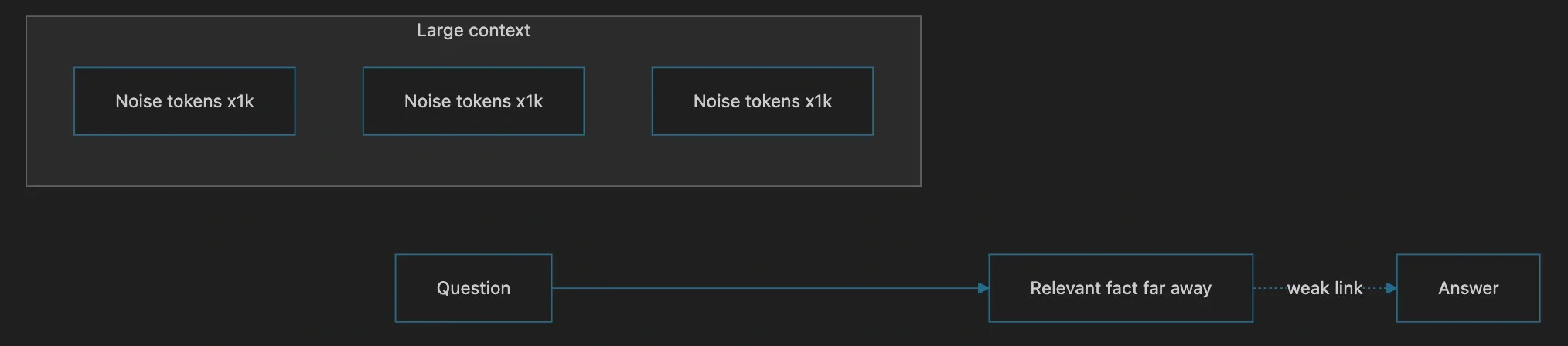
The practical conclusion is that you should stop thinking of the context window as a container you fill, and start thinking of it as a scarce, perishable resource you allocate surgically. The winning agents are not the ones that look at everything, they are the ones that have been taught, through structure, to look at the right few things at the right time.
Retrieval as a structural discipline#
If you cannot dump everything in, you must fetch selectively, and that is what makes retrieval a structural requirement rather than an optional performance tweak. The naive version of augmentation, embed the whole document, retrieve the whole document, stuff it in, is structurally identical to just dumping it in, it inherits the dilution problem. The structural version slices the material into units small enough to reason over, retrieves only the relevant units, and tells the model exactly where each unit came from so it can verify rather than guess.
The unit of retrieval matters enormously and is under-appreciated. Most teams chunk by raw token count, 500 tokens here, 800 there, and then wonder why retrieval pulls out half-chapters that mix several ideas. Semantic chunking, breaking on meaning boundaries, clause, paragraph, section, produces units that are each about one thing, and one-thing units are dramatically easier to reason over because a retrieved chunk does not drag in unrelated material. This is a structural choice at the most basic level.
The embedding model is what detects meaning boundaries, so a semantic chunker groups sentences until the "meaning" jumps, then cuts. The result is nodes that correspond to discrete claims, and retrieval over discrete claims is vastly cleaner than retrieval over arbitrary byte ranges. This is the first place the structural mindset pays off, before you even touch a graph.
The metadata that makes retrieval accurate#
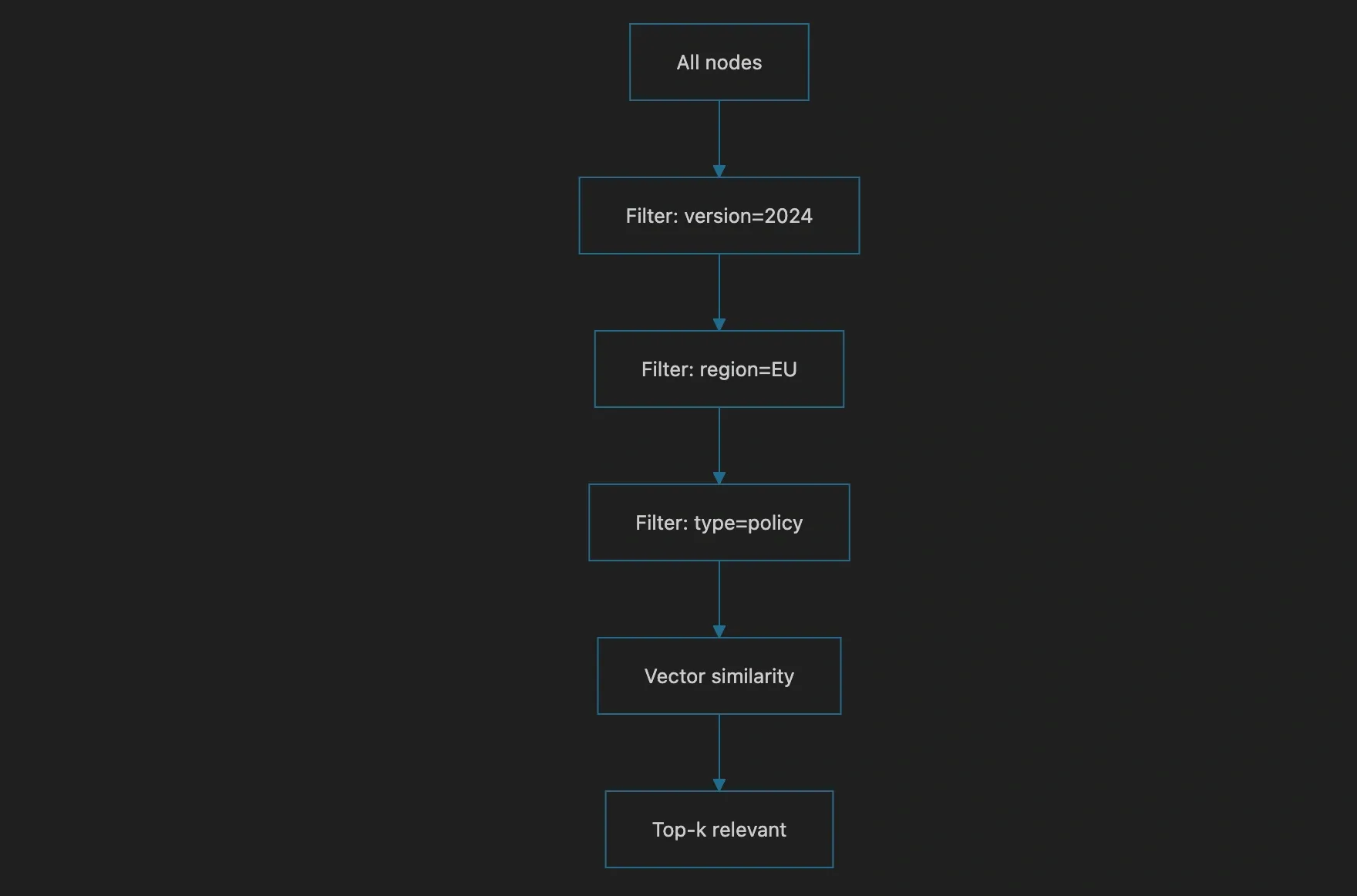
Structure is not just about making units small; it is about labeling them so retrieval can be surgical, and metadata is how you label. The single biggest accuracy win I have seen in RAG systems is not a better embedding model, it is disciplined metadata filtering that runs before or alongside vector similarity. If your corpus has documents from different years, regions, or product lines, and you let pure vector search mix them, your agent will happily answer a 2022 question with 2019 policy. Metadata filters the field before similarity has to work.
This is structural reasoning because it replaces "the model should notice this is the 2024 policy" with "the system has already decided this is the 2024 policy, and the model only has to reason about its content." Independence of reasoning is the goal of all structure: move decisions from the probabilistic model into deterministic code wherever the decision is mechanical. Version selection, region selection, document type selection, these are mechanical, so they should not be left to attention.
The discipline generalizes. Every fact you can encode as a field, filter on it. Every relationship you can encode as a link, traverse it. The model should only be doing the reasoning that genuinely requires inference, and everything mechanical should already be resolved.
Reasoning over structure, not just retrieving it#
Retrieval gets you the right units, but many agentic tasks require connecting units, tracing a requirement from a product spec to a test case, linking a policy to its exception, following a dependency chain across files. Vector search cannot express a relationship; it expresses similarity. Two nodes can be semantically unrelated yet connected by a link, and two paragraphs can say the same thing yet be entirely separate concepts. If your agent's model of the world is "a list of similar text chunks," it cannot do structural traversal.
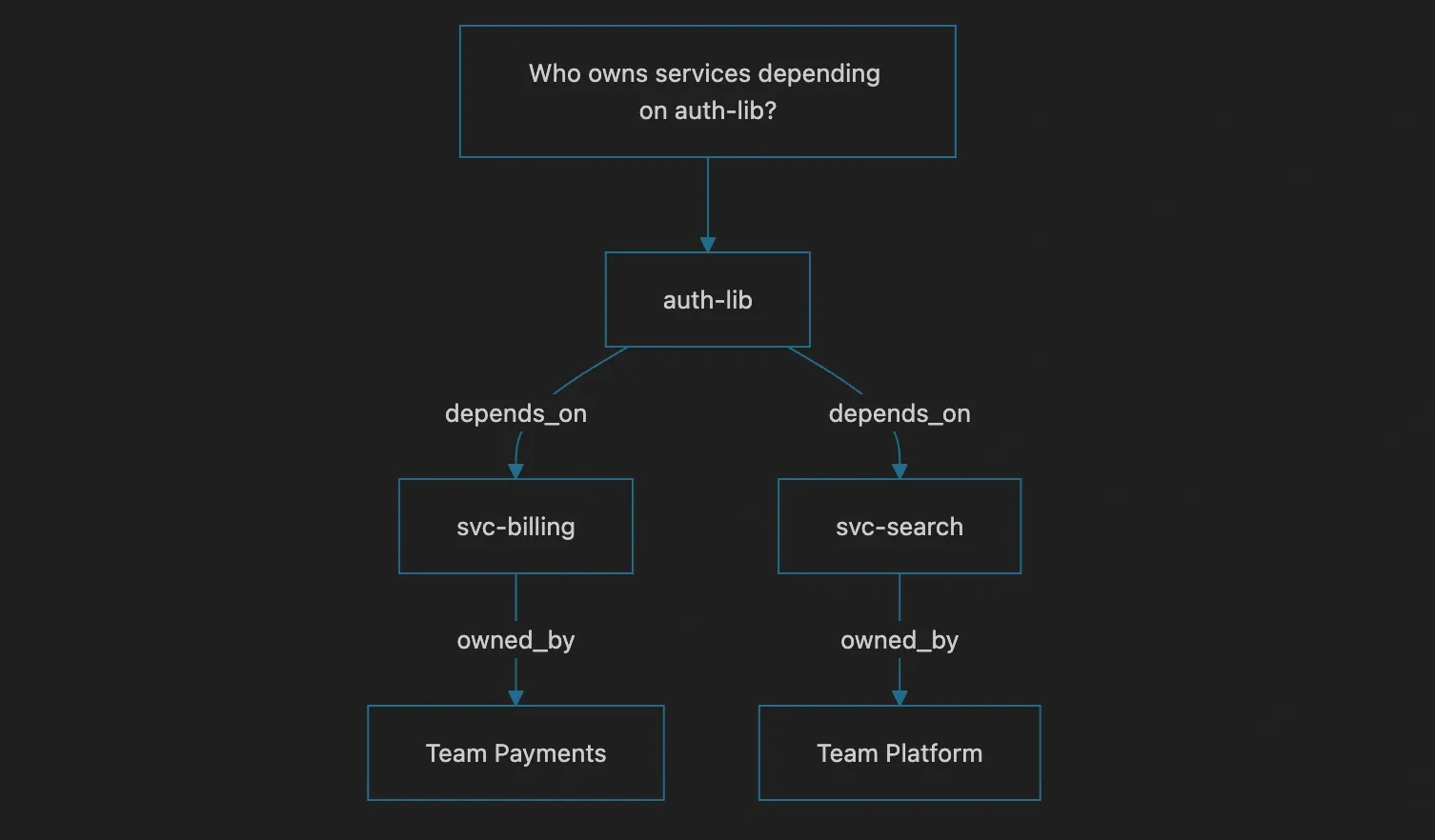
This is where a knowledge graph earns its place. Instead of a flat vector index, you store entities and the relations between them, and the reasoner can move along edges. The classic pattern is GraphRAG: extract entities and relations from your documents into a graph, then answer questions by starting at a relevant entity and traversing its neighbors, which lets the agent answer questions that require connecting distant facts.
The following snippet is illustrative: it sketches the shape of a GraphRAG local-search query rather than a literal call, because the public package's constructor signatures move around between releases. What matters is the pattern, not the exact object names.
The important shift is semantic: the agent is no longer answering by similarity over text. It is answering by traversing a typed structure, ownership edges, dependency edges, so a question about "what depends on X" becomes a graph query the reasoner walks, not an embedding lookup the model guesses at. A flat vector index cannot even express "the teams that own the services," because that is a relationship, not a similarity, and forcing a similarity model to answer it is asking it to invent edges from lexical hints.
Plans as structure for multi-step work#
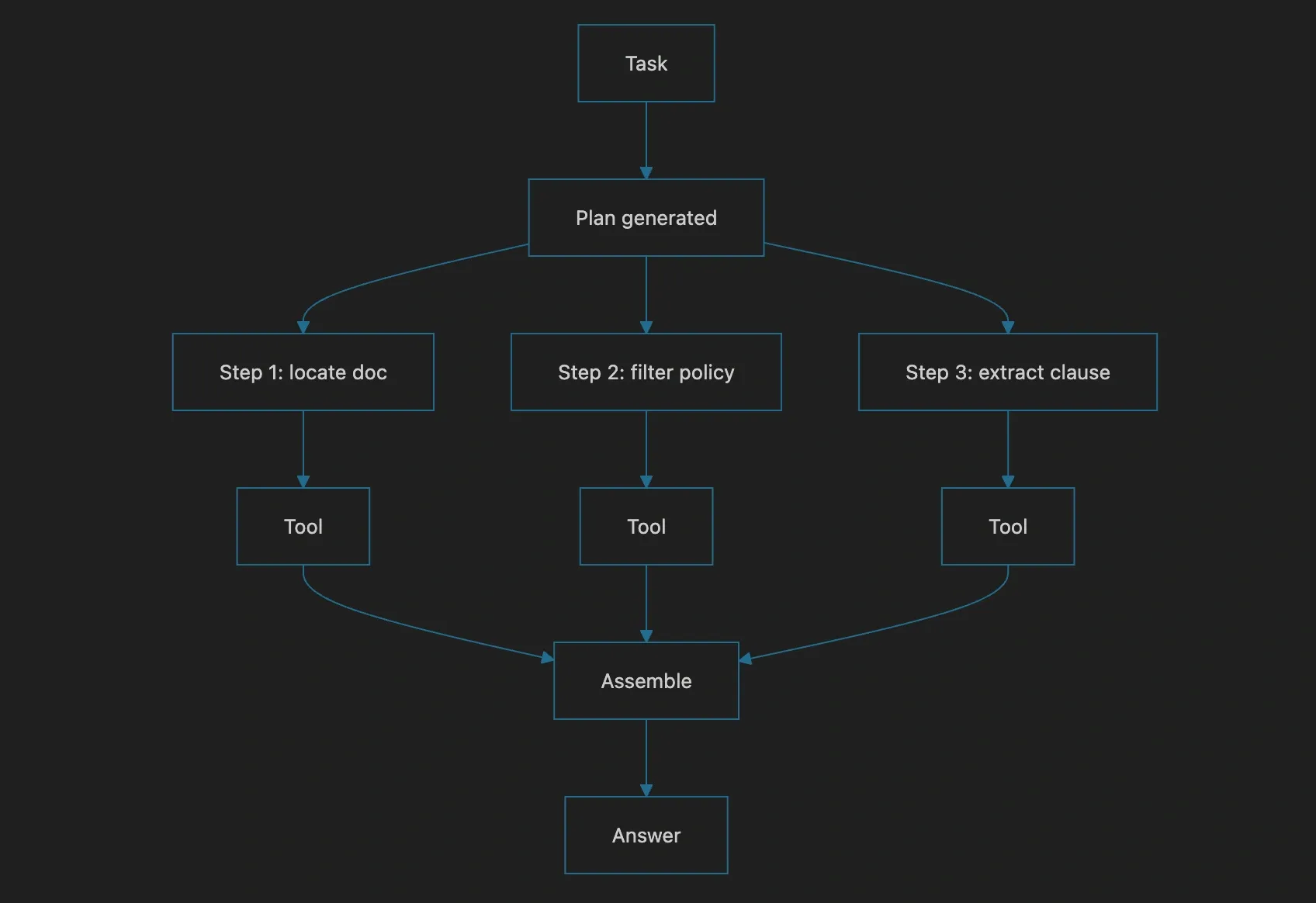
The most underrated structural tool in agentic systems is not retrieval or graphs, it is the plan. A model that plans first, writes down a sequence of steps, and then executes them produces more reliable multi-step work than a model that improvises each step against the whole context. The plan is structure imposed on the reasoning process itself, and it does two things: it forces the model to decompose the task into checkable units, and it gives the system something to verify against.
The ReAct pattern, reason then act, is one version of this structure, and LangGraph's supervisor or planner nodes are more explicit versions. The key is that the plan is not just a prompt nicety; it becomes state that nodes can check and revise.
The plan keeps the model anchored to a path even as local context gets noisy. When step 3 is "find the 2024 EU policy," that step does not have to re-derive the goal from a 9,000-token context, it already knows, from the plan, both the goal and the structure to touch. This reduces dilution because the plan, short and positioned at the front, holds the meta-level while the tools handle the token-heavy specifics.
Structure costs something#
I should be honest that structural reasoning has real costs, or I would be overselling it. Building a semantic chunker, tagging metadata, maintaining a knowledge graph, these are not free. They are engineering work up front, and for a small corpus with a single document type, they may genuinely not pay for themselves. Chunking a 20-token FAQ into semantic units and tagging it with metadata would be absurd. The structure is an investment justified by scale and by the connectivity of the task.
The graph in particular has a real cost curve. Entity extraction is itself an LLM pass over your documents, it is expensive and can be noisy, and a graph full of wrongly extracted entities is worse than no graph, because the agent confidently traverses edges that do not exist. If you go the graph route, budget for entity extraction quality control, and start with the edges that your queries actually need rather than modeling every conceivable relationship.
But the cost framing cuts both ways. The default, dumping everything into a context window, also has a cost, it is just invisible and compounding. It shows up as confusing answers, as retries, as the occasional embarrassing wrong answer in production, and nobody can point at where the cost went. Structure front-loads the cost into visible, fixable engineering. That is a trade I will take nearly every time.
The position that matters#
Longer context is a convenience, not a solution. It hides the structural problem, that agents reason best about small, well-labeled, explicitly connected units, by letting you believe that more text will fix what better organization should fix. The moment your agent has to reason across many pieces of information rather than answer from one, you have crossed a line where the context window is the wrong tool and structure is the right one.
The strongest agents you will build are not the ones that ingest the world. They are the ones that have had the world arranged for them: chunked into one-idea units, filtered to the right version and region, connected by real edges, and planned into verifiable steps. Every decision you move out of the model's attention and into deterministic structure is a decision that stops being probabilistic and becomes reliable. That is the whole game. Stop trying to make the model hold more, and start deciding how much it needs, and making the rest impossible to get wrong.
Want to Master Spring Boot and Land Your Dream Job?
Struggling with coding interviews? Learn Data Structures & Algorithms (DSA) with our expert-led course. Build strong problem-solving skills, write optimized code, and crack top tech interviews with ease
Learn more