Practical Guide to Building Software Engineer Resumes that Get Shortlisted
Ex-Amazon SDE | Reviewed 10,000+ Resumes | Software Engineer Resume Examples & Template (2026 FAANG Guide)

Anuj Kumar Sharma
February 10, 2026
10 min read
Check out this FREE AI Resume Builder Tool: AI Resume Builder
If you are reading this, chances are that your resume is not getting shortlisted. Don’t worry, you are not alone. I’ve helped thousands of students at Coding Shuttle fix this exact problem. Today, I’m sharing the exact formula that gets resumes shortlisted at FAANG and other product-based companies.
In this guide, I will be sharing what exactly what works and what doesn't - with real resume examples from students who got into Google, Amazon, and Microsoft. I've reviewed thousands of resumes and formulated a list of what works and what doesn't.
What Actually Works?#
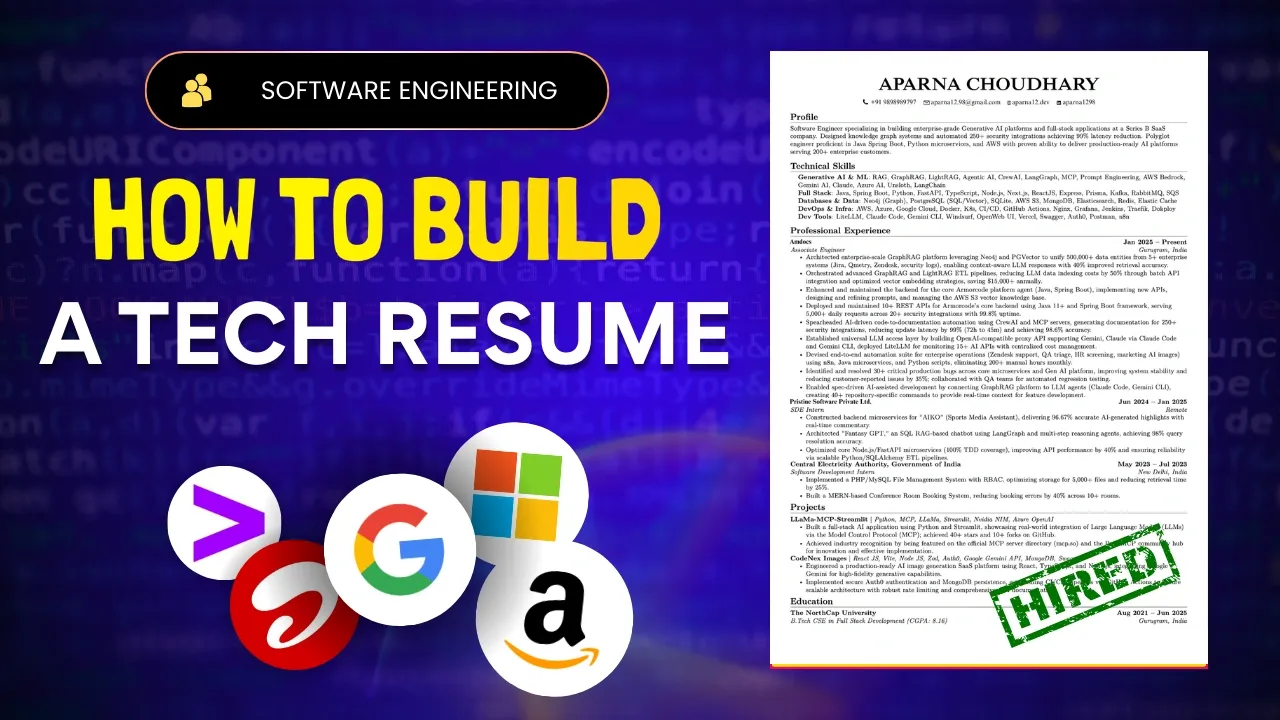
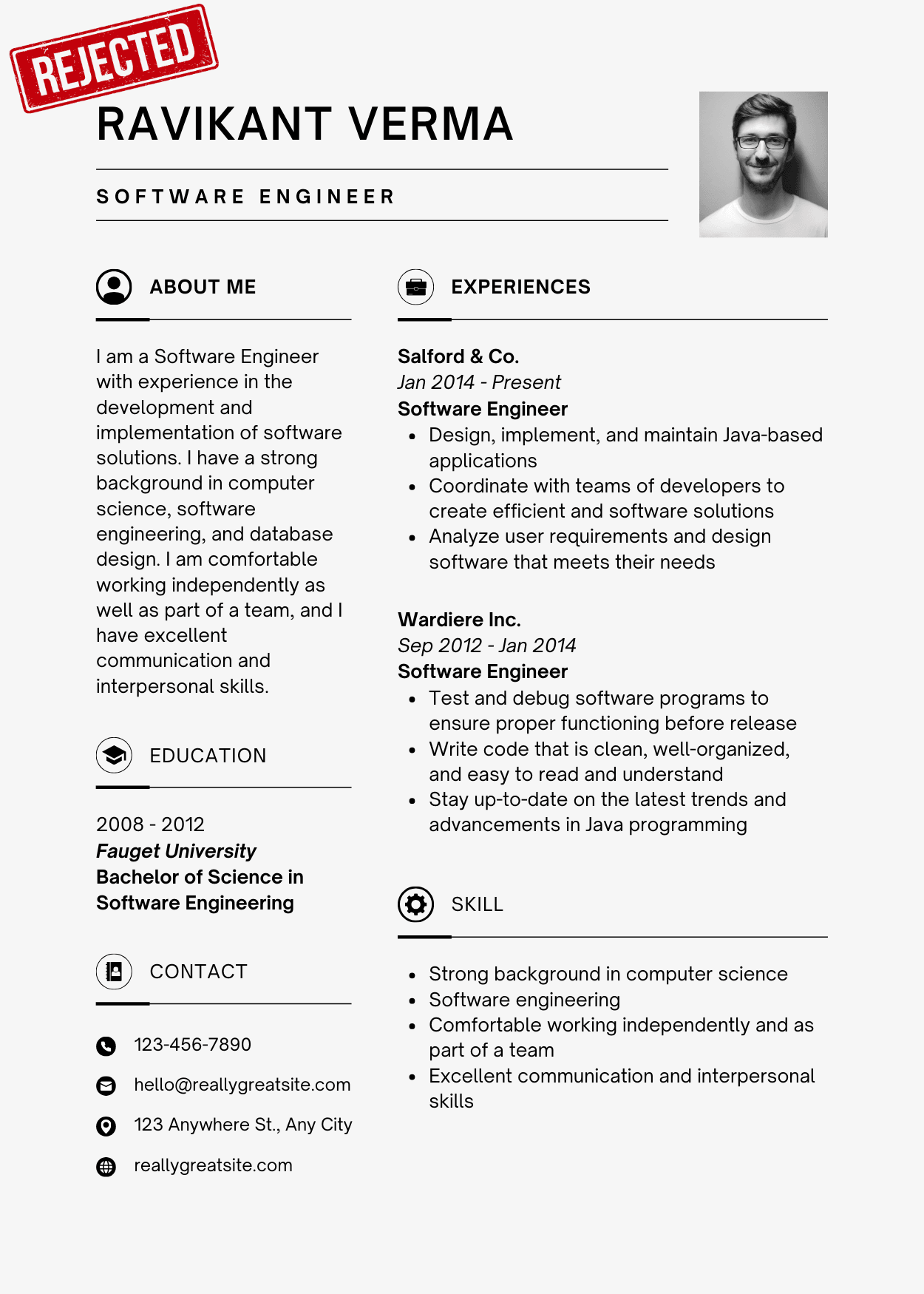
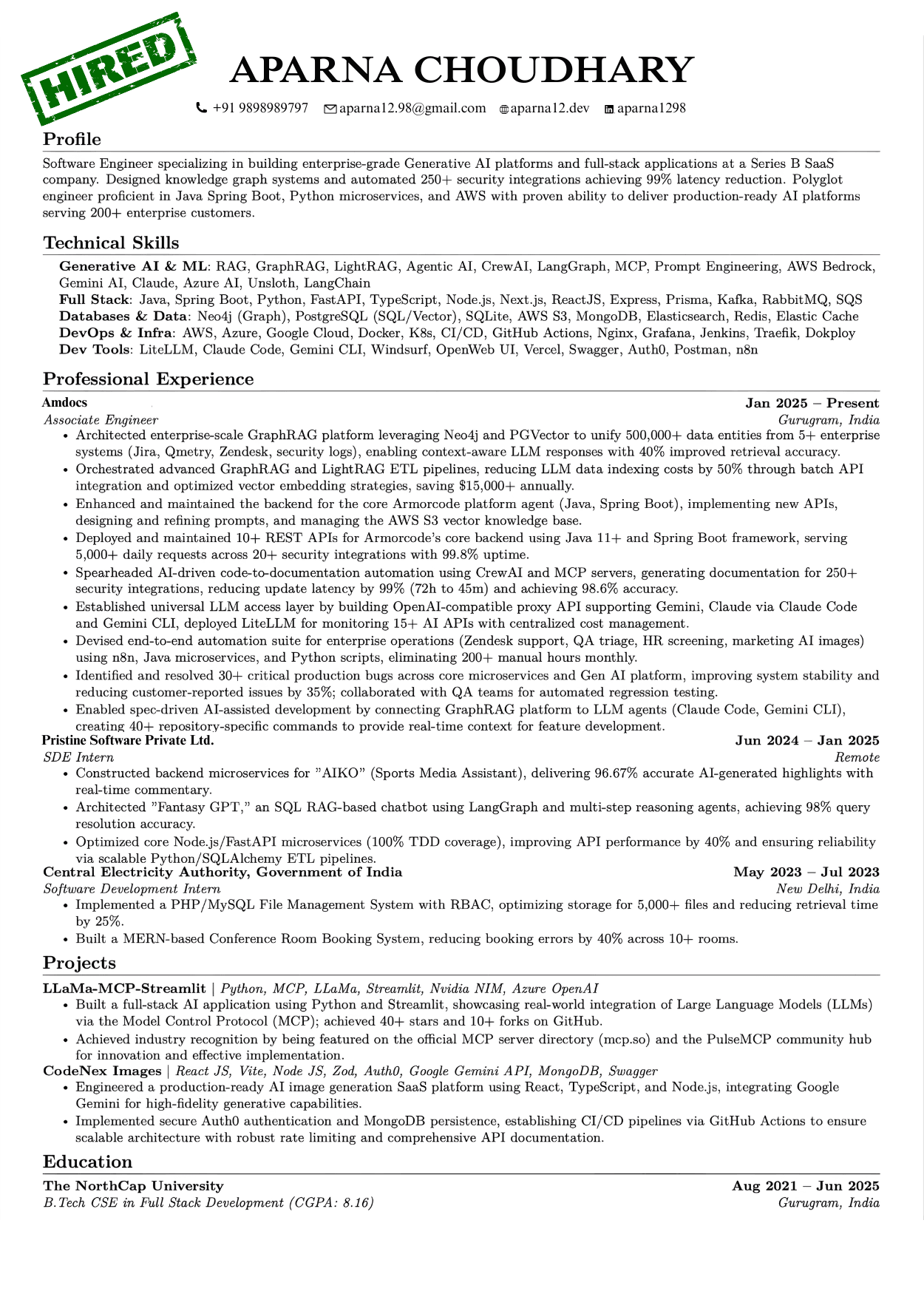
Look at these two resumes. Both are fresh graduates and look very similar, but there's a stark difference.
One got interviews at Amazon, Uber, and Google. The other got zero responses after 50+ applications.
What's Wrong With Ravikant's Resume?#
- Photo on resume - Photos create bias and waste precious space that should be used to highlight important skills.
- "About Me" section - It is too generic and doesn't specify any actual data points for recruiters to consider as soft and personal skills.
- No quantifiable numbers - Phrases such as "Design, implement, and maintain Java-based applications" as such do not add any value unless they are supported by quantifiable numbers to show the impact created. It can be rephrased as: “Designed, implemented and maintained Java based applications that are over 50 internal stakeholders every day and generate $100k in annual revenue”.
- Skills section is not well defined - "Strong background in computer science" specifies educational background. Skills would be things learnt while studying computer science, eg: DSA, Kafka, Springboot etc. You should specify as many as possible, but only the ones you are proficient in as this would be the base for the interviewer to ask questions.
- 10 years of experience (Jan 2014 - Present) - Work experience should be detailed, yearwise preferably. Work experience must be in chronological order, detailing projects you have worked on and impact created. Promotions can also be mentioned. Eg: 2014-16 - SDE 1; 2016-18 - SDE 2.
Don't overcomplicate things. Your resume has one job: to get you an interview. Keep it clean, keep it simple, and let your skills speak for themselves.
What Makes Aparna's Resume Work?#
Look at her first bullet point:
“Architected enterprise-scale GraphRAG platform... unifying 500,000+ data entities... 40% improved retrieval accuracy”
- Specific technology: GraphRAG, Neo4j, PGVector
- Scale (well quantified): 500,000+ data entities
- Impact (well quantified): 40% improved accuracy
This is what most recruiters want to see in a resume. Your resume should showcase the impact you created in the previous roles you worked in. Here's how you can transform your weak bullet points to stronger points.
Transform Weak Bullets Into Strong Ones#
After reviewing 10,000+ resumes, I've seen people making the same mistakes over and over again. So I created a simple formula that works every time:
[Action Verb] + [What You Built] + [Tech Stack] + [Measurable Result]
Here's a comparison table with real examples:
| Weak Bullet (Gets Rejected) | Strong Bullet (Gets Interviews) | Why It Works |
|---|---|---|
| Worked on improving app performance | Optimized React rendering and implemented code-splitting, reducing load time from 3.2s to 890ms (72% faster) | Shows exact improvement with numbers |
| Developed features for e-commerce site | Built one-click checkout using React + Stripe API, increasing conversions by 23% and adding ₹3.5L monthly revenue | Business impact in rupees, specific tech |
| Part of backend team | Led API migration to microservices using Docker + K8s, cutting deployment time from 45min to 4min | Leadership + time savings |
| Fixed bugs and improved code | Resolved 52 bugs in Q2 2025 using automated testing (Jest + Cypress), reducing support tickets by 34% | Quantified work + downstream impact |
Software Engineer Resume For Freshers: The Projects Strategy#
"But Anuj, I'm a fresher. I don't have work experience. How do I show impact?"
For freshers, your projects and internships ARE your experience.
I've seen even bootcamp grads get interviews by treating projects like professional work. Here's how:
❌ Bad Project:#
This could be anyone's project. Zero differentiation.
✅ Good Project (What Gets Interviews):#
What makes this work:
- It mentions real users (847)
- Includes tech depth (Plaid API, Lambda, aggregation pipelines)
- Metrics and numbers wherever possible (99.3% uptime, 74% faster, ₹25K saved)
- Live proof (deployed app + GitHub stars)
How To Quantify Impact (Critical)#
"I'm a junior dev. I don't have access to analytics. What do I do?"
You don't need perfect data. You need smart estimates. Also, you should ask your product managers; they usually track all these metrics.
Here are 6 types of metrics that always work:
| Metric Type | Examples | How To Get Numbers |
|---|---|---|
| Performance | "Reduced API time from 2.3s to 340ms" | Chrome DevTools, monitoring tools, or time it yourself |
| Scale | "Handling 1.2M requests/day" | Database counts, server logs, Google Analytics |
| Business | "Increased conversion by 3.2%" | Product dashboards, or ask your PM |
| Time Savings | "Cut deployment from 2hrs to 8min" | Time yourself before/after |
| Quality | "Reduced bugs from 47/week to 8/week" | JIRA tickets, error monitoring (Sentry) |
| Volume | "Resolved 52 high-priority bugs in Q2" | Count your tickets, PRs, commits |
My trick when I applied to Amazon:
Instead of: "Improved database performance."
I wrote: "Optimised PostgreSQL with composite indexes, reducing response time from ~2.5s to ~400ms (estimated 85% improvement from local testing)."
Nobody expects freshers to have perfect analytics. What they DO expect is that you pay attention to your impact and can talk about it.
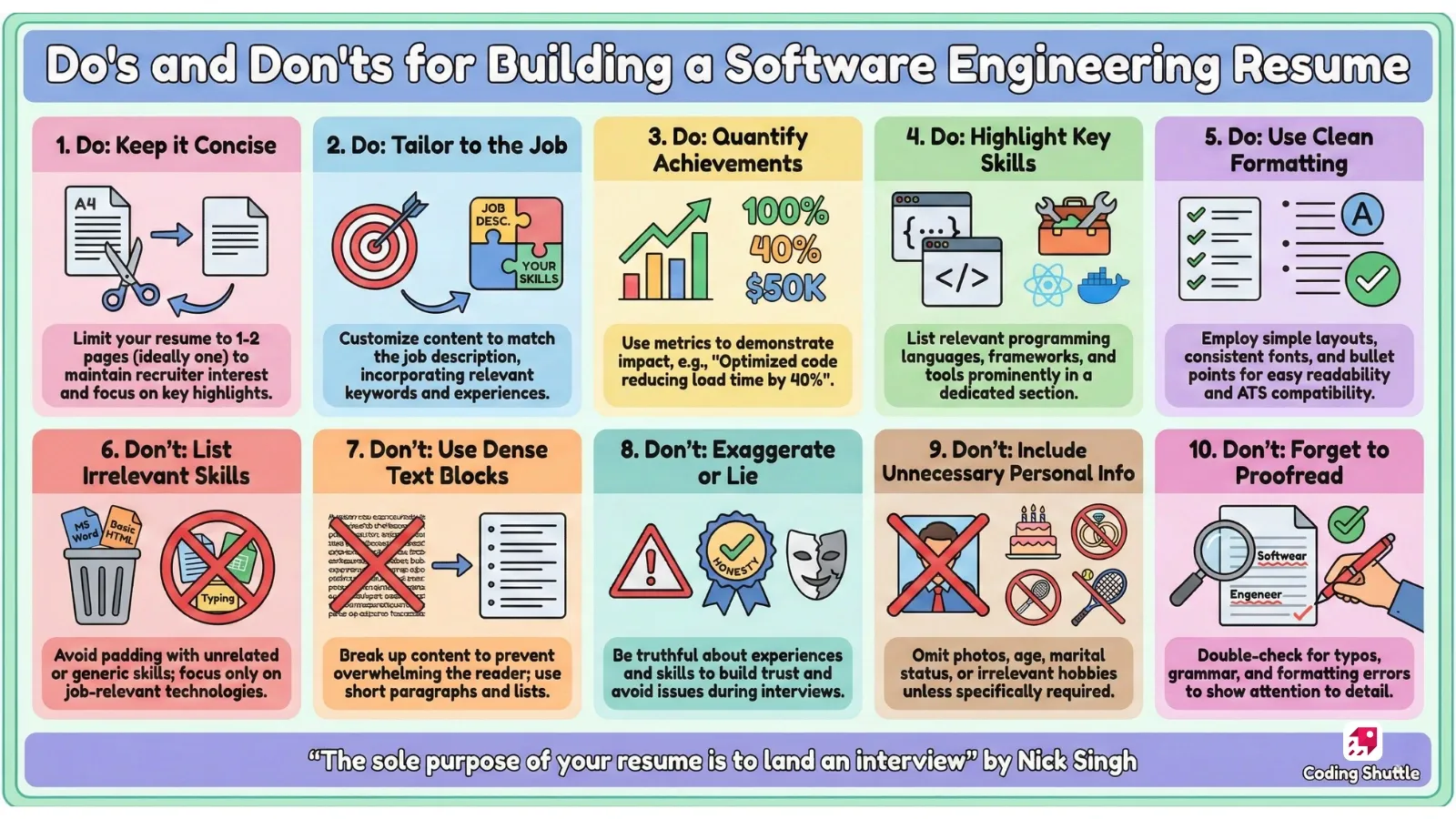
✅ Do This:#
Clean, single-column layout - Top to bottom flow
Standard headers - "Work Experience," "Education," "Skills" (not “My Journey”)
Simple formatting - Bold + regular text only Standard fonts - Arial, Calibri (10-12pt)
Save as PDF - Unless told otherwise
Example header:
❌ Don't Do This:#
- Two-column layouts (breaks parsers)
- Tables or text boxes (scrambles info)
- Headers/footers for contact info (often skipped)
- Fancy fonts or graphics
- Photos (unless you're modelling)
Section-By-Section Templates (Copy-Paste Ready)#
Skills Section#
❌ Wrong Way:
✅ Right Way (Like Aparna's Resume):
Why this works:
- Grouped by category
- Specific tools mentioned (not just "AWS" but actual services)
- Shows depth, not breadth
Experience Section#
❌ Wrong Way (Like Ravikant's):
This shows zero impact and just responsibilities. You should avoid writing experience section like this.
✅ Right Way (Like Aparna's):
See the pattern? Every bullet has:
- Strong verb (Architected, Reduced, Spearheaded)
- Specific tech (Neo4j, PGVector, CrewAI)
- Numbers (500K entities, 40%, $15K, 99%)
You can also use the AI tools in this Free AI Resume Builder to generate strong impactful experience bullet points like these.
Projects Section Template#
Why We Built The Free AI Resume Builder#
After seeing the same formatting issues 10,000 times, I got frustrated. Students are spending HOURS writing bad resume with Google Docs.
So we built a free tool that handles formatting automatically and helps you focus on what actually matters - showing your value.
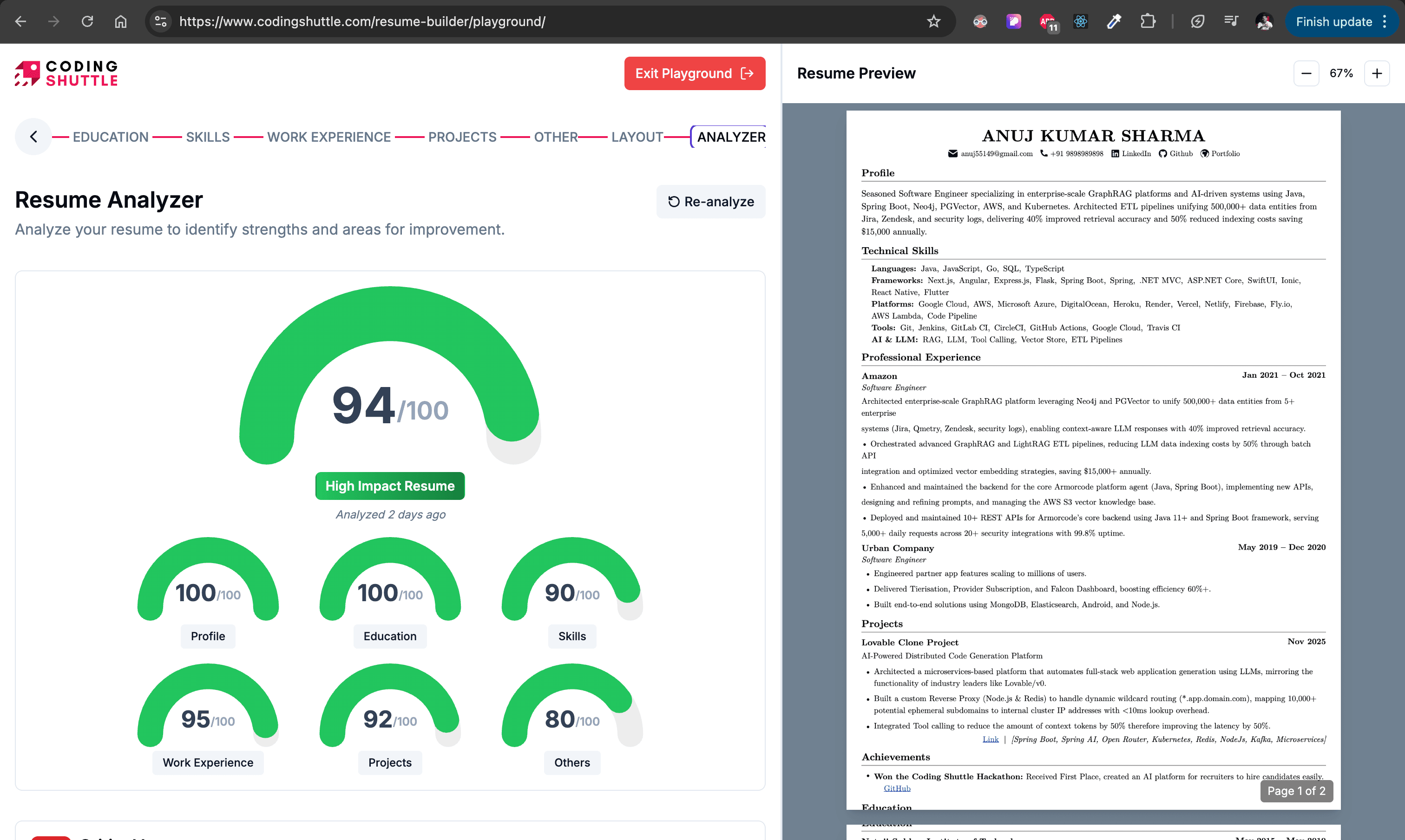
What It Does:#
1. AI Impact Enhancement
You type: "improved app performance from 3.2s to 1.1s."
Then the AI will automatically rewrites this as: "Optimised React rendering with code-splitting, reducing load time from 3.2s to 1.1s (66% faster)"
2. Real-Time ATS Checks
It shows you:
- ✅ Format will parse correctly
- ⚠️ Skills section too long
- ❌ Missing GitHub link
FAQ: Questions I Get Asked Frequently#
1. Should I include GPA on my resume?
Only if you are a fresh graduate and it is exceptional (above 8.5/10 or 3.5/4.0). If you have work experience of over 4 years, then you can avoid adding it all together.
2. How long should a software engineer's resume be? One page.
Unless you have 10+ years of experience, keep it to one page. Recruiters usually spend 20 seconds max to go through a resume.
3. What font is best for tech resumes?
Stick to the classics: Arial, Calibri, Roboto, or Open Sans. Size 10-12pt.
4. Should I put a photo on my resume?
For US/UK/India tech jobs: No. It introduces bias and takes up valuable space. For some European/Asian countries, it might be standard, but for FAANG and other product-based companies, you should skip it.
5. How do I list "Soft Skills"?
You should not just list them, you should show them. Instead of writing "Leadership," write a bullet point: "Led a team of 3 juniors to deliver X."
6. Do I need a summary/objective section?
Generally, no. It takes up space. Unless you are making a drastic career switch (e.g., Marketing to Coding), skip it. But if you have some space left in your resume, then a good professional summary can be added to fill up the resume as well.
7. Are "Interests" sections necessary?
Avoid stuff like “Watching movies”, “Reading Novels”, etc. "State-level Chess Player" or "Open Source Contributor" is good. But these lines should be added in the “Achievements” section instead of calling it Interests.
8. How do I handle employment gaps?
Be honest. If you took a year to upskill, list it as "Career Break - Professional Development" and list the courses/projects you did.
9. Should I include my address?
City and State/Country are enough. "Gurugram, India." Avoid adding the full street addresses.
10. What if I have no experience?
Focus heavily on the Projects section. Treat your projects like jobs. List the tech stack, the challenges, and the outcome. Contributing to Contributing to Open Source projects is an excellent strategy for building relevant experience.
Your Checklist Before Hitting Submit#
- [ ] Every bullet has a strong action verb
- [ ] 70%+ bullets include specific numbers
- [ ] Technologies are specific (not "cloud" but "AWS Lambda, S3")
- [ ] Most impressive stuff is in the first 2-3 bullets
- [ ] Projects show real usage (users, stars, metrics)
- [ ] One page for <5 years, max 2 for seniors
- [ ] Professional email (no
coolcoder123@yahoo.com) - [ ] Zero spelling/grammar errors
- [ ] Saved as PDF with good name (FirstName_LastName_Resume.pdf)
- [ ] No tables, text boxes, or fancy formatting
- [ ] Matches job description keywords
If you checked all, you're ready to apply.
Most rejections happen at resume stage. Not because you can't code, but because you can't communicate your value.
Final Thoughts#
Three things to remember:
- Quantify everything - "Improved performance" is useless. "Reduced latency from 2.3s to 340ms" is gold.
- Show impact, not responsibility - Nobody cares you were "responsible for API." They care that you "optimized API, cutting costs by ₹3.5L/month."
- Make it scannable - Put your best work at the top.
Ready to build a resume that works?
Use our free AI resume builder and get it done in 10 minutes. Completely free.
Want to Master Spring Boot and Land Your Dream Job?
Struggling with coding interviews? Learn Data Structures & Algorithms (DSA) with our expert-led course. Build strong problem-solving skills, write optimized code, and crack top tech interviews with ease
Learn more