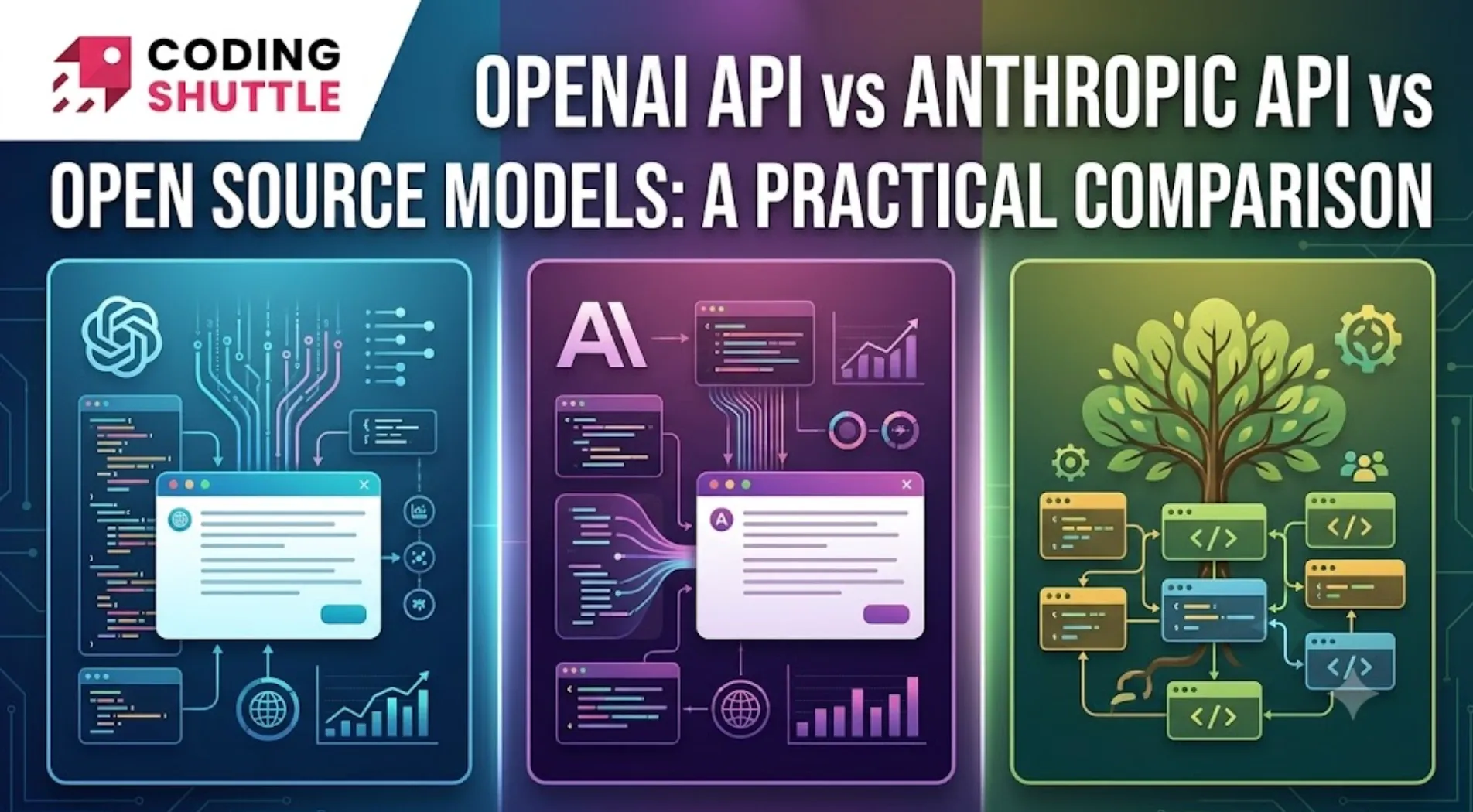
OpenAI API vs Anthropic API vs Open Source Models: A Practical Comparison
Choosing between a managed API and open weights sets your control-versus-convenience tradeoff: Anthropic and OpenAI hide hosting behind per-token pricing, while Ollama and vLLM run models you fully own at the cost of infrastructure. The article lists when each wins. Includes the portability concerns of switching providers.

Shreyash Gurav
August 29, 2026
5 min read
OpenAI API vs Anthropic API vs Open Source Models: A Practical Comparison
Every AI project starts at the same fork in the road. Do you rent intelligence from OpenAI, rent it from Anthropic, or run open weights yourself? Teams burn weeks debating this before writing a line of code, which is backwards, because the decision is more reversible than it looks. Code does accrete around a provider though, so the default you pick matters more than the debate you have about it.
What You Are Actually Choosing Between#
Strip the branding away and you are deciding how to split responsibility. With a managed API, someone else buys GPUs, keeps them cool, patches inference servers, ships model updates, and charges you per token. You write application code. With open source models, you download weights and run inference yourself, whether that means Ollama on a laptop or vLLM on a rack, and you inherit everything those companies were doing for you: capacity planning, uptime, security patches, model upgrades.
Neither is a scam. They are different positions on a control-versus-convenience spectrum, and the right position depends almost entirely on your constraints around data, cost structure, and staff.
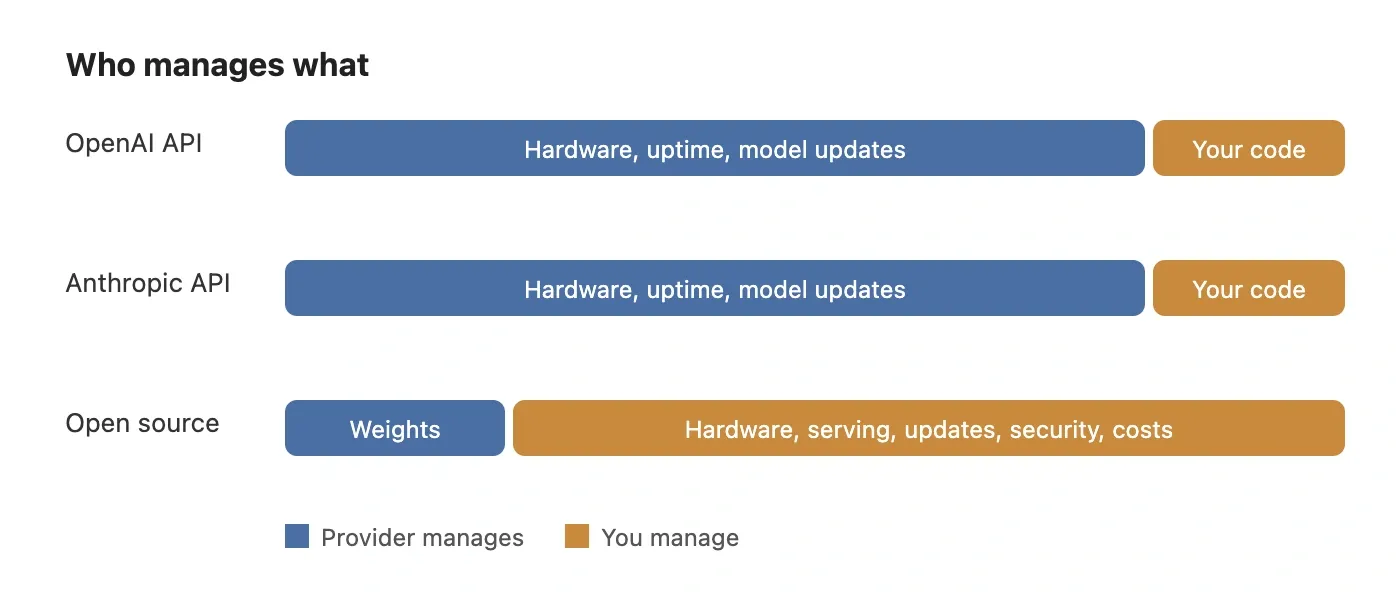
The Two Managed Giants#
Both companies sell frontier intelligence by the token, both are reliable, and both will serve most applications equally well. The practical differences are smaller than the tribal arguments suggest, but they are real.
The API shapes differ. OpenAI centers everything on chat.completions with a messages array. Anthropic uses a messages endpoint where max_tokens is mandatory and system instructions sit in their own parameter rather than inside the message list:
Ecosystem gravity differs too. OpenAI's schema became the industry's lingua franca: serving tools like vLLM and Ollama expose OpenAI-compatible endpoints precisely so existing code works unchanged. If you value maximum off-the-shelf compatibility, that gravity helps. Anthropic competes hard on model quality, long-context coherence, and controllability, and plenty of teams prefer its behavior on nuanced instruction-following. Both handle streaming, structured output, vision inputs, and function calling well.
My honest advice: pick either, then hide the choice behind one function in your codebase. Ten minutes of wrapping buys you permanent freedom to swap.
The Open Source Route#
Open weights come in families: Meta's Llama, Mistral, Alibaba's Qwen, Google's Gemma, DeepSeek, among others. Sizes range from phone-class few-billion-parameter models to monsters requiring serious GPU clusters. Running one locally is genuinely one command with Ollama:
For production serving, vLLM wraps open models in that same OpenAI-compatible API, so downstream code barely notices the difference.
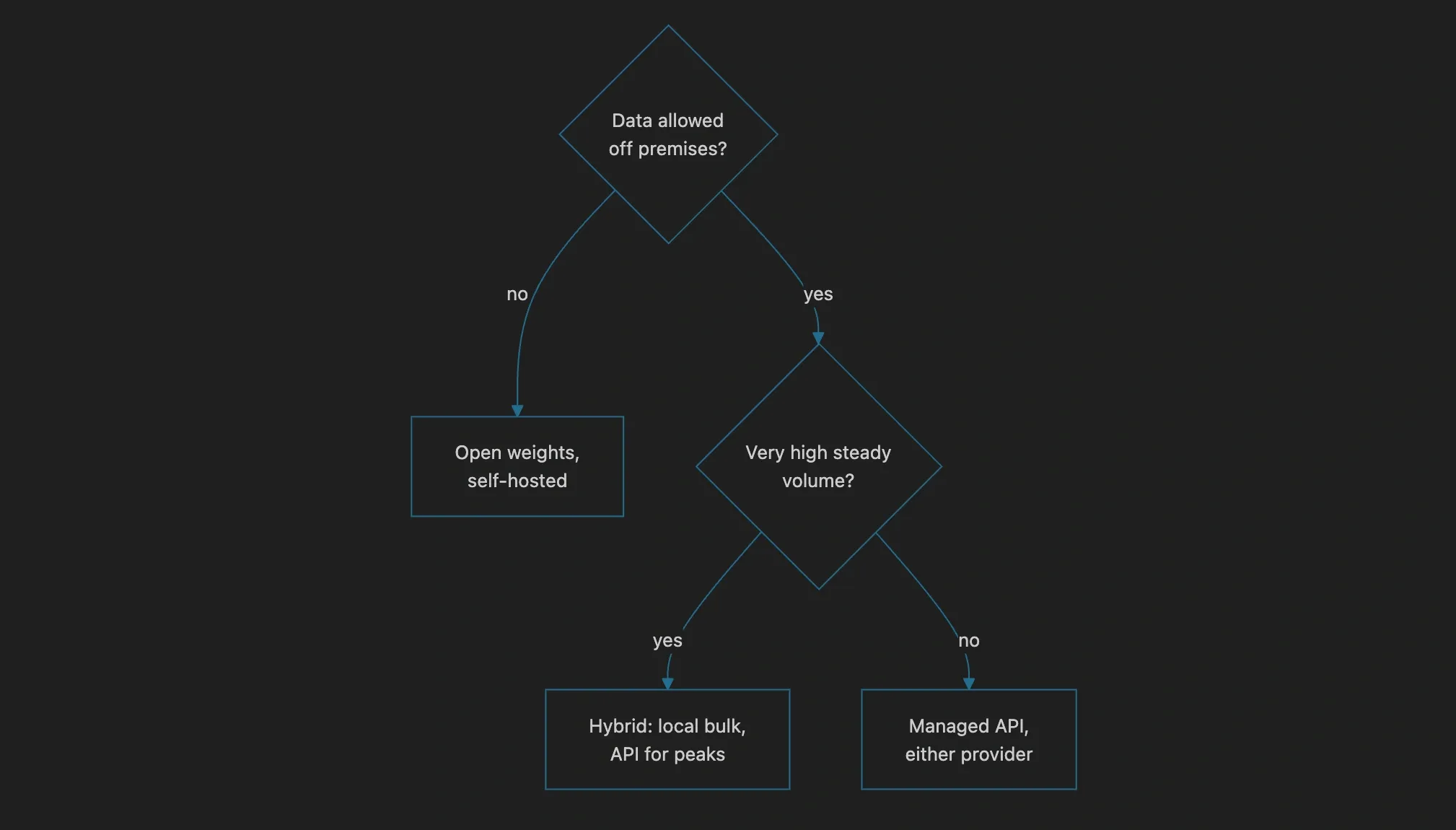
People go open source for four honest reasons. Regulation or contracts forbid sending data to an external API, common in healthcare, finance, and defense. Steady massive volume makes per-token pricing worse than owning hardware. The deployment target has no reliable internet. Or the team wants to fine-tune and truly own model behavior.
And people regret it for equally honest reasons: they suddenly operate infrastructure, frontier models still beat open ones on hard reasoning, and the engineering hours spent tuning throughput are hours not spent on the product. Free weights are not free delivery.
Where Each Option Bites Back#
Every route has a recurring bill. Managed APIs bill in dollars and dependency: price changes, model deprecations, and occasional capacity hiccups arrive on someone else's schedule, not yours. OpenAI's enormous ecosystem means most friction has already been solved somewhere; it also means more of your architecture silently assumes its conventions. Anthropic's ecosystem is somewhat leaner, and rate limits on some access tiers require planning around bursts. Open source bills in engineering time: evaluation burden, serving tuning, upgrade testing, and the quiet discovery that your carefully benchmarked model choice matters less than your retrieval quality.
None of these are disqualifying. They are just costs that show up on different ledgers. Compressed to the constraints that actually decide it:
Route Instead of Marrying#
The strongest pattern in production is refusing to pick just one. Frontier API for the hard reasoning calls, a cheaper provider for bulk summarization, a local model for classification workloads where latency beats brilliance, with automatic fallback when any provider degrades:
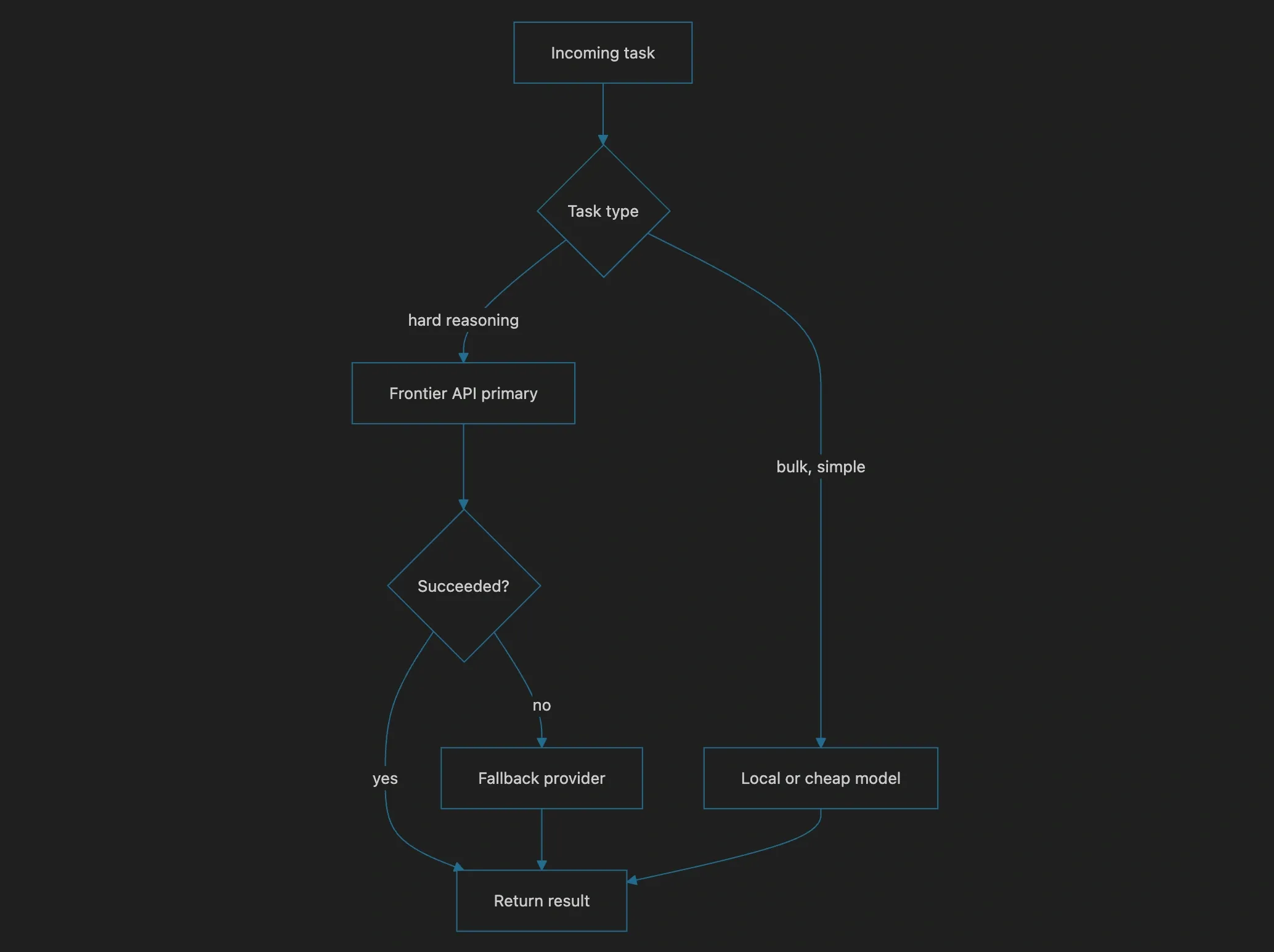
Routing gives you resilience and unit economics that no single-provider setup matches, and it only works if you kept provider calls behind an interface instead of scattering SDK imports everywhere.
A Default That Works#
If you want a rule instead of a debate: prototype on whichever managed API your team knows better, wrap every call behind one internal module, push latency-insensitive bulk work onto local or cheap models once volume makes the math obvious, and commit to full self-hosting only when law or unit economics force your hand. Teams that follow this progression rarely look back with regrets. Teams that architect around a single provider on day one usually rewrite within a year.
Want to Master Spring Boot and Land Your Dream Job?
Struggling with coding interviews? Learn Data Structures & Algorithms (DSA) with our expert-led course. Build strong problem-solving skills, write optimized code, and crack top tech interviews with ease
Learn more