Multi-Agent Systems: When and Why to Use Them
Multi-agent systems are only worth their cost when a task decomposes into genuinely independent subgoals, and the article shows a LangGraph planner-researcher-writer split with structured outputs between nodes. It inspects where delegation beats a single loop and where it compounds failure. Includes coordination and evaluation guidance.

Shreyash Gurav
August 29, 2026
11 min read
Multi-Agent Systems: When and Why to Use Them
Consider what happens when two models are asked to finish a job that one of them could probably do alone: a carefully worded handoff between them can quietly lose a detail, and the second model reasons from an incomplete picture without knowing it is missing something. That one failure, information lost at the boundary between agents, is the load-bearing fact behind the whole multi-agent debate. Every few months the term gets a fresh coat of hype and suddenly every demo is a swarm of specialized AIs chatting, but the judgment that actually matters is whether the split pays for itself. Most multi-agent architectures turn out to be over-engineering, and some problems genuinely need them. This article is about telling the two apart before you burn engineering months and a four-figure monthly model bill.
This article is about that judgment. I will be clear up front: a multi-agent system is a specific tool for a specific class of problems, and the trigger is never "it would be cool" and rarely "it is good practice." The trigger is that your task, by its nature, has parts that will be handled better and more reliably when you split them across separate models with separate scopes, separate tools, and separate context. If your task does not split that way, adding agents does not just fail to help, it makes things worse, and I will show you the exact mechanics of how.
Why one agent is usually the right answer#
Before asking when you need many agents, let me state the default position bluntly: start with one. A single agent with a good model, a clear toolset, and a decent context window can handle an enormous range of tasks. When it cannot, the failure is usually not a problem with the number of agents, it is a problem with prompt quality, tool design, or context management, and adding agents will not fix those, it will fertilize them.
Here is the concrete mechanism behind that claim. Every agent you add is a new model call, a new prompt you must maintain, a new place for errors to enter the system, and, critically, a new point where information must be handed off from one model to another. That handoff is where the trouble lives. When agent A produces a result for agent B, B only knows what A chose to write down, and if A summarized badly or left out a relevant detail, B reasons from an incomplete picture and cannot see what it is missing. With a single agent, the entire context is in one place, so no detail is lost in translation, at the cost of that context getting crowded.
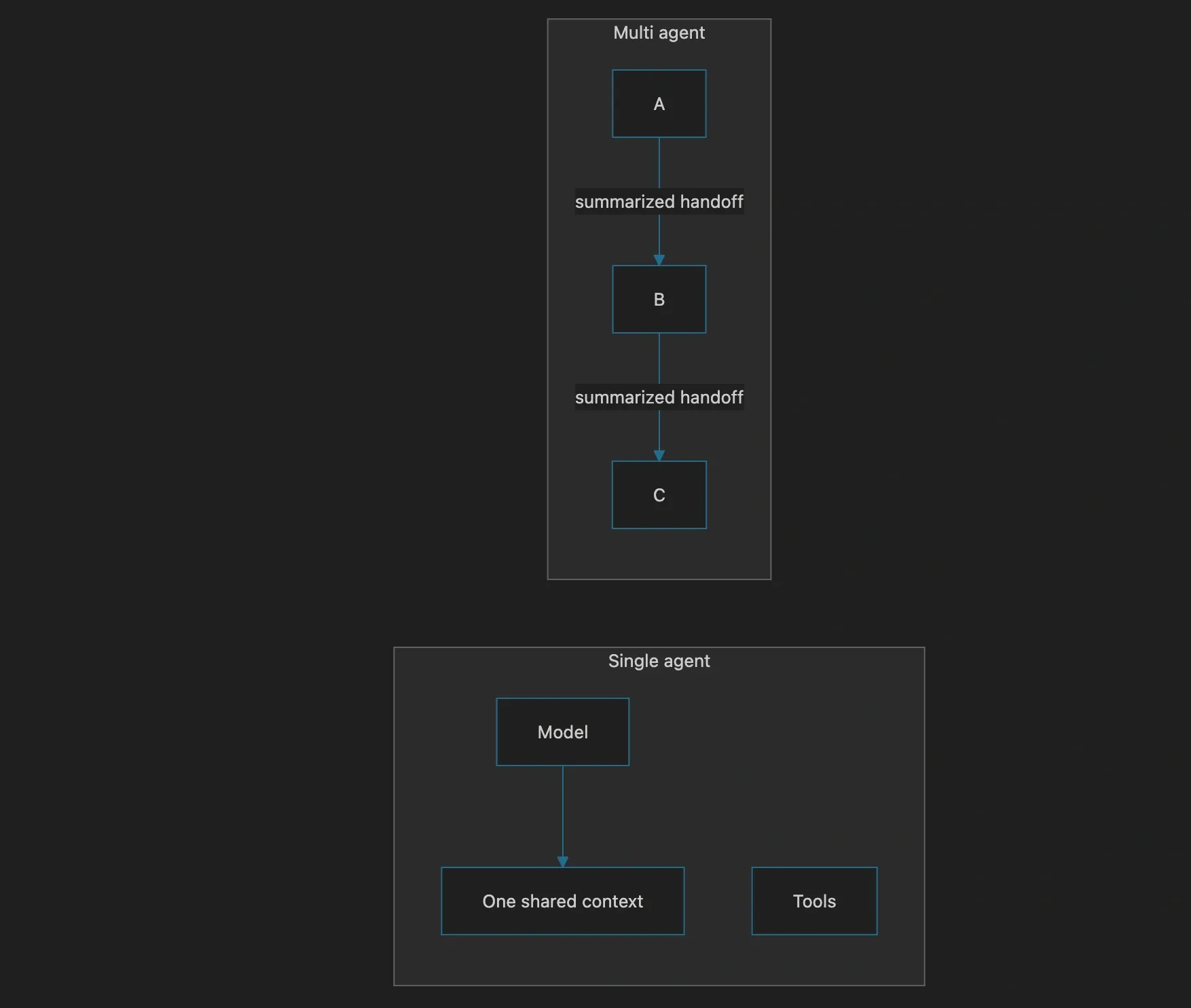
So the decision is a genuine trade, not obviously good either way. One agent trades context crowding for zero information loss in handoffs. Many agents trade clean scopes for information loss at every boundary. You go multi-agent when the clean scope is worth more than the handoff loss.
The three reasons that justify splitting#
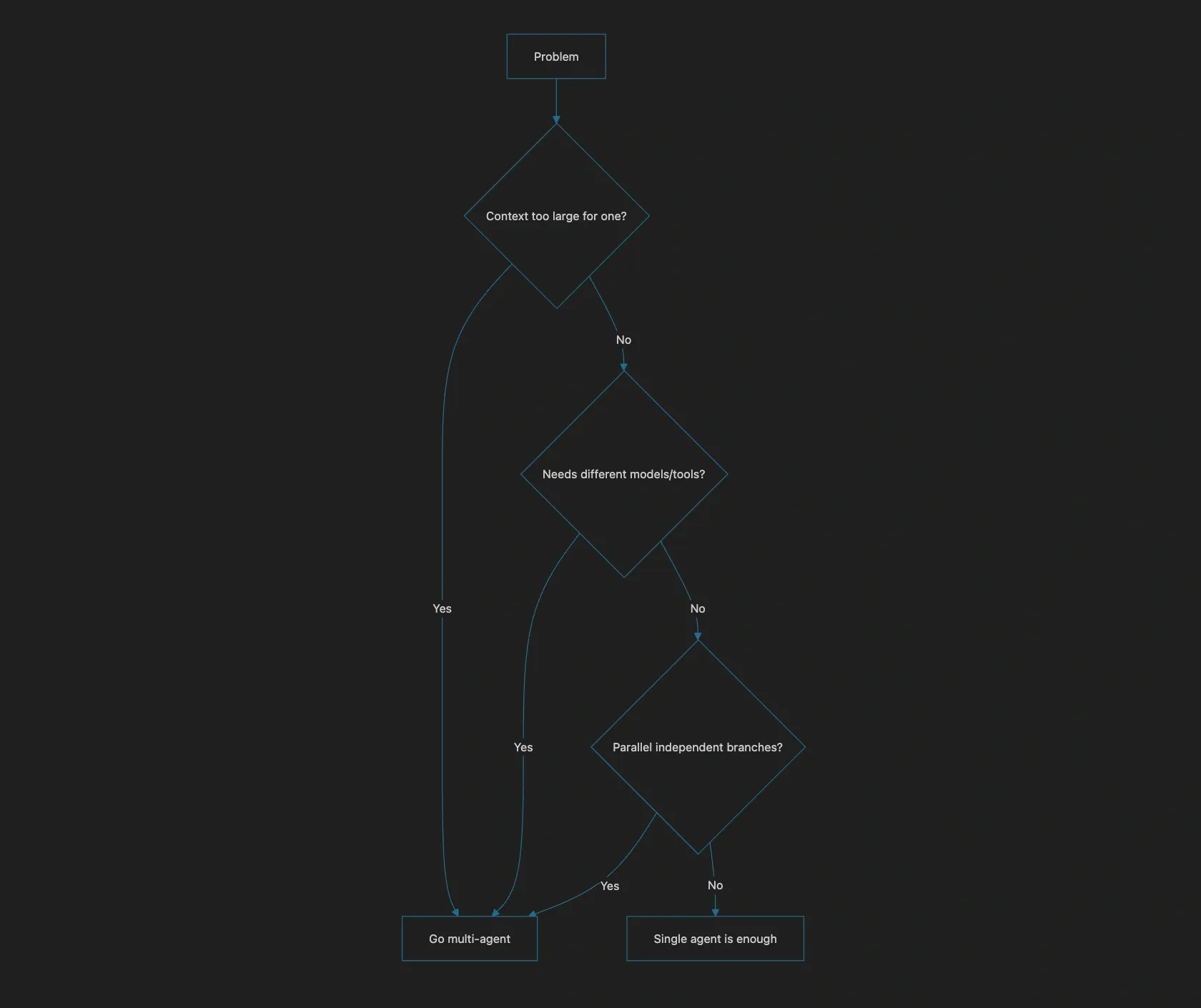
There are, in my experience, exactly three reasons that justify a multi-agent architecture, and if your problem does not hit one of them, you do not have a multi-agent problem, you have a prompt or a single-agent problem.
The first is context containment. Some tasks produce more intermediate state than one model can hold. If you are processing a 200-page contract and then making a decision about it, or analyzing a large codebase and then writing a fix, a single agent either busts its context window or degrades as the relevant material scrolls out of attention. Splitting lets a "reader" agent work over the huge document incrementally and hand off only a distilled finding to a "decision" agent with a clean context.
The second is specialization. A task that genuinely needs very different capabilities, say drafting legal text and then querying a graph database, often benefits from different models. You might run the drafting on a strong general model and the database queries on a cheap, fast model with RAG or SQL tools, because you do not want the expensive generalist spending tokens on tool plumbing. When the sub-tasks need different models, different tools, or different safety profiles, separate agents let you tune each independently.
The third is concurrency. If a task has independent parallel branches, like researching five sources and then synthesizing, parallel agents can run simultaneously and cut wall-clock time dramatically. A single agent is sequential, it reads source one, then source two, etc. Five parallel research agents finish in roughly the time of one. This is the reason that is easiest to feel, because it shows up as latency, but it is worth noting it only helps for genuinely independent branches. Forcing parallelism onto a dependent pipeline just moves the serialization.
What a real multi-agent system looks like#
Let me show you the shape of a legitimate one before the failure modes, so you have something concrete to compare against. The canonical pattern is an orchestrator that plans and delegates, plus worker agents that each own a sub-task, plus a way to collect results.
I will build this with LangGraph, because it gives you the sub-graph and state-passing primitives for free, and I will keep it realistic: a research and report system where a planner picks sources, each source gets a dedicated researcher, and a writer assembles the final report.
Notice what is happening. Each researcher is a separate agent with its own model instance and, in principle, its own context and tools. The orchestrator does not do the research itself, it delegates, so the planner's context never fills with source material. The writer sees only the findings dict, not the raw sources, which is exactly the handoff loss I mentioned, and the writer has to trust that the researchers distilled faithfully.
I structurally separate that handoff by marking section_findings as a dict, not a list of messages, so the writer cannot even see the researcher reasoning, only their conclusions. That is a deliberate design choice. It keeps the writer's context clean, and it also means the writer cannot double-check the research, which is the cost.
The failure modes that make teams regret it#
Now the part the architecture diagrams never show. Multi-agent systems fail in predictable, expensive ways, and knowing them beforehand is how you keep from being the team that learns them the hard way.
The first failure is error compounding through handoffs. Each agent introduces a small error rate, and in a chain those errors multiply rather than cancel. If each handoff has a 5 percent chance of garbling meaning, three handoffs give you roughly a 14 percent chance that something important got mangled, and you will not know which hop did it. This is why honest multi-agent designs add a reviewer or a verification node at the end, and why pure chains, where every agent's output feeds the next with no oversight, are the worst possible topology. You are paying for the compounding with no mitigation.
The second failure is cost and latency blowup. Every agent is an inference call, and the loops between them add network hops. A five-agent orchestrator can easily produce ten or twenty model calls for what a single agent might do in three. The concurrency benefit cuts latency only when branches actually run in parallel; if your "orchestrator" waits serially on each agent, you pay full latency for every hop and get none of the parallelism. Measuring this is the first thing you should do, not the last.
The third failure is the coordination tax. Agents that need to agree on shared information end up re-explaining context to each other, and that re-explanation is not free, it eats tokens and drifts accuracy. The more interdependent the agents, the more they duplicate context, and eventually you have reconstructed a single shared context at multiple times the cost. This is the failure that most directly contradicts the "clean scope" justification. If your agents need constant information from each other, they are not independent, and you built a chatty mess.

The architectures that actually make sense#
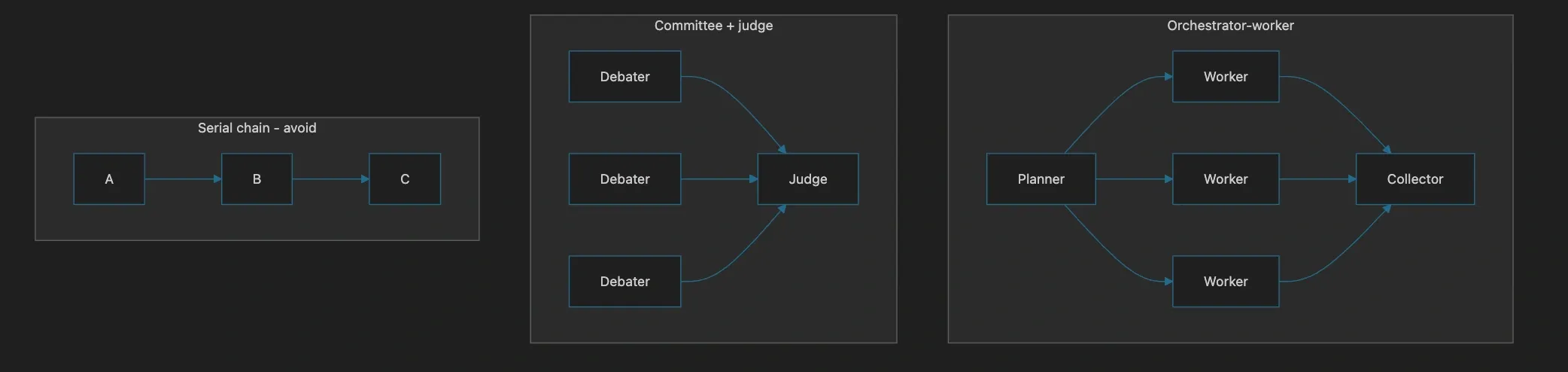
Not all multi-agent topologies are equal, and the shape you choose matters more than the count. In my experience there are three that survive contact with reality, and one pattern you should avoid.
The orchestrator-worker pattern is the workhorse. A single planner splits the work, dispatches to focused workers, and a collector assembles results. It is simple, it maps to how teams actually work, and it is the easiest to debug, because the handoff points are explicit and few. This is the default choice.
The pipeline pattern, where agent A hands to B hands to C, is the one I would caution against in the naive serial form, but it becomes reasonable when each stage is genuinely a different processing phase with a reviewer between stages. If you are going to use it, add a verification step, because pure chains are where error compounding bites hardest.
The committee or debate pattern, where multiple agents reason about the same problem and a judge picks the best answer, is real but expensive, and I reach for it extremely rarely. It genuinely helps on high-stakes single decisions where a second opinion catches mistakes, but you are paying N times the inference cost for diminishing returns. If you do use it, cap the number of committee members and measure whether more members actually improve the judge's accuracy, frequently they do not after two or three.
A practical gate for deciding#
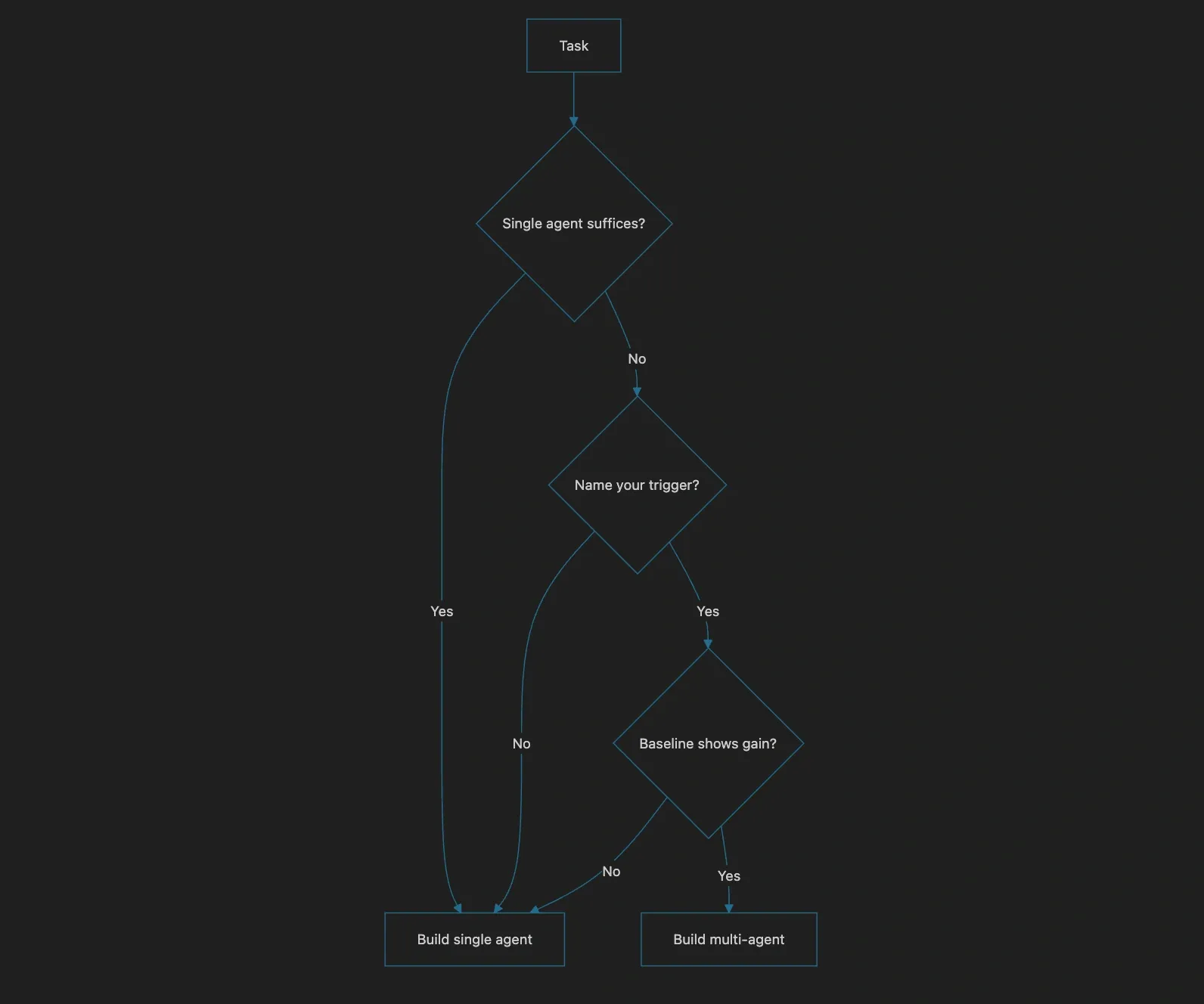
Since I promised judgment rather than rules, here is the decision procedure I actually use, and it has prevented more bad architecture than any framework. I write it as a checklist you run before committing to multi-agent.
First, can a single model with good tools and chunked context handle it? If the answer is even a hesitant yes, build the single agent first. Multi-agent is a second pass you make with evidence in hand, not a first guess. Second, if you do feel pressure to split, name which of the three triggers you are hitting: context containment, specialization, or concurrency. If you cannot name one, you are splitting for aesthetics, and you will pay for it.
Third, and this is the step almost everyone skips, before building the full multi-agent system, prototype the equivalent single-agent version and measure its accuracy, cost, and latency. That baseline is your yardstick. If the multi-agent version does not beat it on at least one axis that matters, it is not an improvement, it is an expensive parallel universe. Every team I have seen go multi-agent without that baseline regrets it, because they cannot tell whether the added complexity bought anything.
The position worth holding#
Multi-agent is a legitimate architecture, but it is a specialty tool, like a distributed transaction protocol or a sharded database, that you pull out for a specific, named reason, not a default you reach for because the term sounds sophisticated. The overwhelming majority of agent tasks are better served by one well-built agent with clean tools and disciplined context. And the teams that build the best multi-agent systems are usually the ones who resisted it longest, because by the time they split, they can prove the split pays for itself on a measured baseline.
The real point, the one the demos bury, is that the sophistication you want is not in the number of agents, it is in the controlled handoffs and the measured payoff. A two-agent system that provably beats a single agent because it contains an enormous context is better engineering than a five-agent swarm that re-explains the same state to itself and costs four times as much. Build the boring thing first, measure it, and let the evidence, not the excitement, decide whether your task earns the complexity.
Want to Master Spring Boot and Land Your Dream Job?
Struggling with coding interviews? Learn Data Structures & Algorithms (DSA) with our expert-led course. Build strong problem-solving skills, write optimized code, and crack top tech interviews with ease
Learn more