LangChain vs LlamaIndex vs Raw API: When to Use What
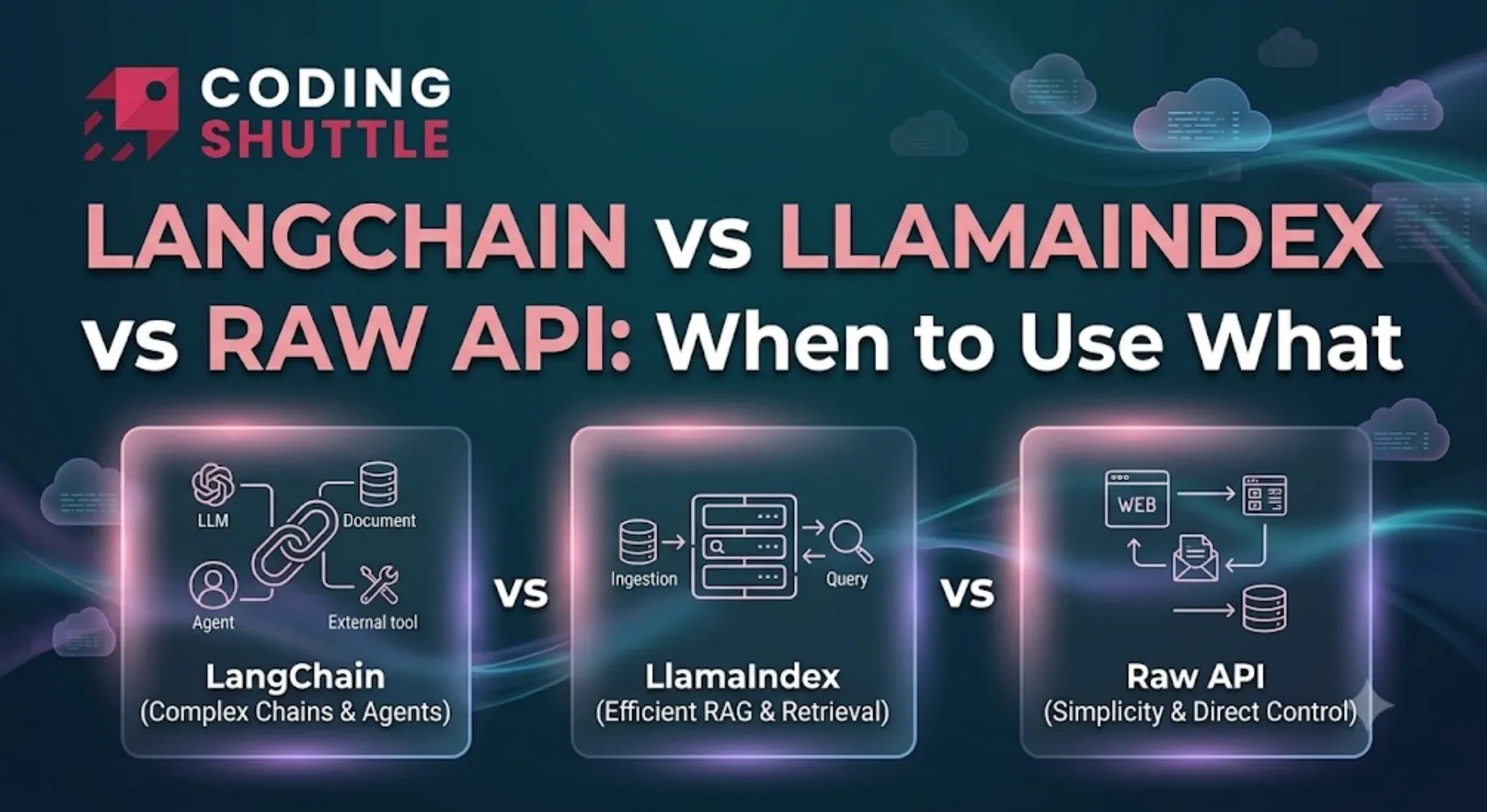
Three integration layers answer the same need at different depths: LangChain as orchestration, LlamaIndex as a data framework, and raw SDK calls as the floor. The tradeoff is abstraction versus control, since higher layers accelerate early work but obscure the model loop. The article picks where each stops paying.

Shreyash Gurav
August 29, 2026
5 min read
LangChain vs LlamaIndex vs Raw API: When to Use What
Framework debates generate more heat than light because people argue about tools that solve different problems. LangChain is an orchestration framework. LlamaIndex is a data framework. Raw provider SDKs are neither, and sometimes they are the correct answer anyway. Here is what each is actually for, the same task built three ways so you can feel the difference, and the decision rule I use after watching teams succeed and suffer with all three.
Three Tools, Three Different Jobs#
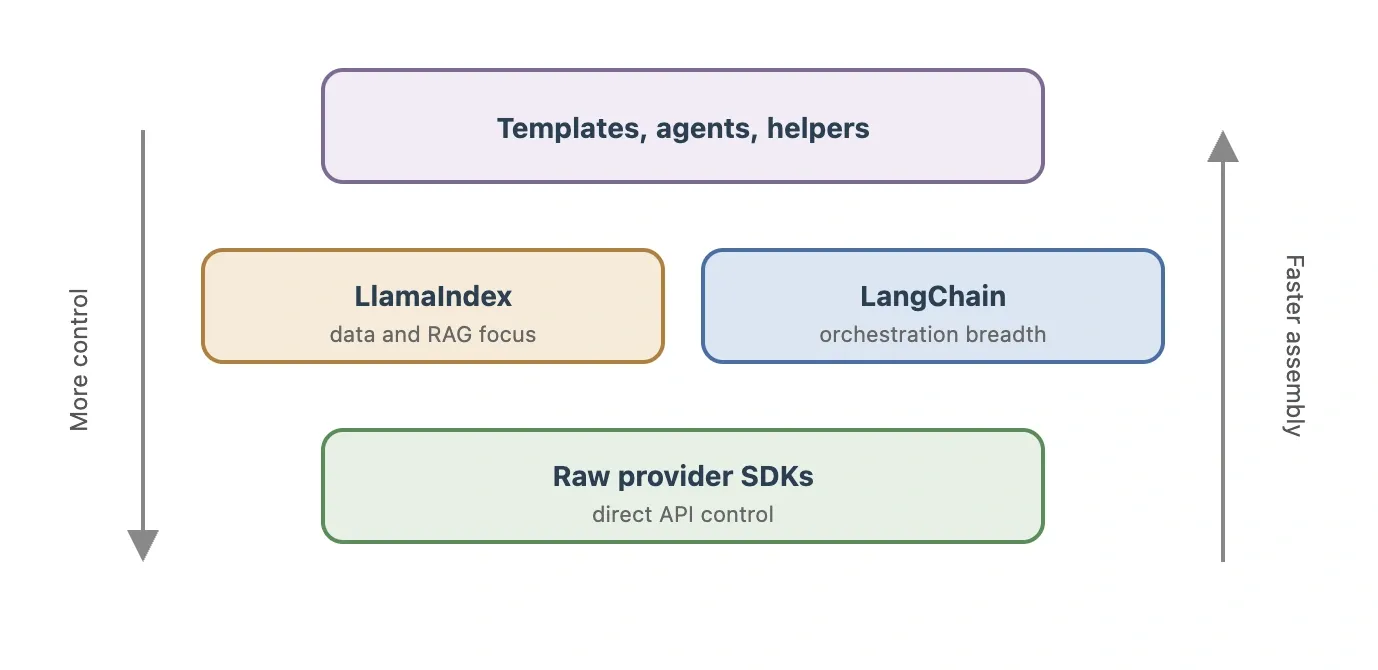
LangChain's center of gravity is orchestration: composing multi-step pipelines from interchangeable parts, wiring models to tools and memories and retrievers, with a large integrations catalog behind a uniform interface. Its value proposition peaks when your application chains heterogeneous components together.
LlamaIndex's center of gravity is data flowing into and out of models: loaders for dozens of source formats, document parsing and node splitting, index construction, retrieval strategies, query engines. It compresses the entire ingestion-to-answer pipeline harder than anything else in the ecosystem.
Raw SDKs, meaning direct OpenAI or Anthropic calls, offer no composition at all and total control instead: every token, retry, and schema decision passes through code you wrote and can therefore debug.
The trade each layer makes:
Same Task, Three Ways#
Task: answer questions over a folder of markdown notes. First, raw, which needs about twenty lines once you have an embed helper: read the files, embed chunks, cosine similarity with numpy, stuff the top hits into a prompt, call the chat API. You have written every line; nothing surprises you at 2am.
LlamaIndex compresses the identical pipeline to its essence:
Five lines covering loading, chunking, embedding, indexing, retrieval, prompting, generation, and synthesis. That compression is the product.
LangChain expresses it as a composable chain, trading some brevity for explicit wiring:
The pipe syntax is elegant once learned, and the structure pays off when steps multiply. But notice the dependency list: four packages beyond the SDK itself, plus FAISS under the hood where the raw version used numpy you already had.
The Case for Staying Raw#
Most LLM applications are a handful of calls with schemas, retries, and maybe one retrieval step. For those, frameworks add moving parts faster than they remove code. Stack traces route through abstractions you did not write. Token accounting hides inside wrappers. Dependency churn arrives on someone else's schedule. And the skills atrophying underneath you, prompt design, context management, cost control, are precisely the ones that make you good at this regardless of which framework wins next year.
There is also a debugging asymmetry worth respecting. When raw code fails, the bug lives in your fifty readable lines. When a deep framework chain fails mid-agent-loop, diagnosis can involve reading library internals on a deadline. Engineers who learned raw first report that frameworks feel like conveniences; engineers who started there often cannot diagnose below the abstraction at all.
When Frameworks Earn Their Keep#
Honest triggers for adoption exist. You need many heterogeneous data connectors and do not want to hand-write parsers: both frameworks' loader catalogs are genuinely valuable. Your application swaps models or providers frequently and uniform interfaces pay rent. You are building agentic loops with tool registries that upstream maintainers keep compatible for you. Or standardizing a team: one shared idiom for chains beats five engineers' personal styles.
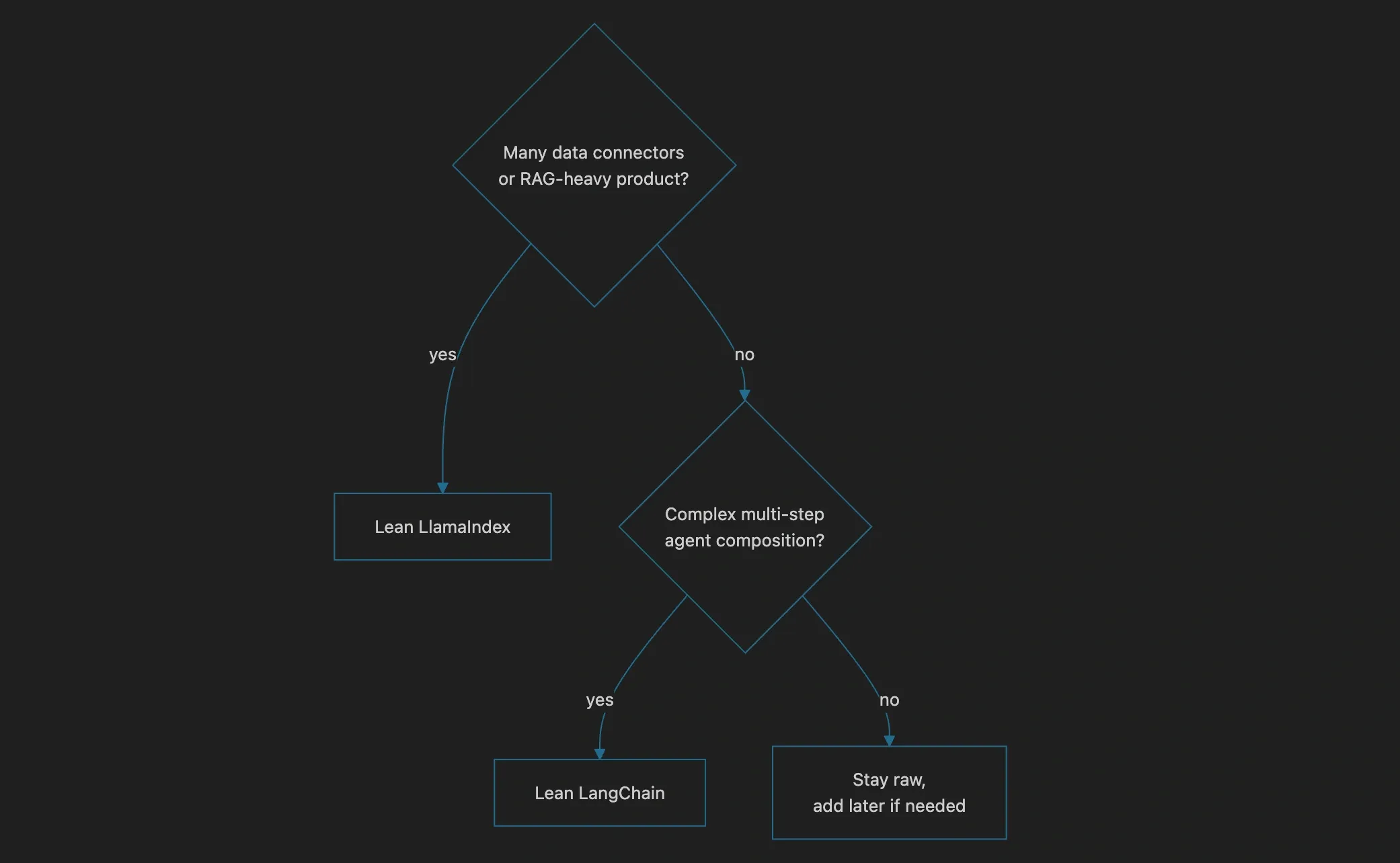
Between the two, choose by center of gravity. If the product is fundamentally search-and-synthesis over messy corpora, LlamaIndex is the sharper instrument. If the application composes many steps, branches, tools, and state, LangChain's orchestration fits better. Teams routinely use both in one system without contradiction.
They Can Coexist#
Mature stacks often look like this, and it surprises people who assume a winner must emerge:

LlamaIndex handles ingestion and retrieval against a real vector store; LangChain orchestrates whatever agent behavior surrounds it; hot paths that demand transparency drop to raw calls. Layer boundaries stay clean because each piece earns its place rather than arriving as a bundle default.
Decide With a Flowchart:
Adopt on Evidence#
Whatever you pick, wrap model access behind one internal module anyway, because providers change pricing, models deprecate, and your future self deserves options. Then run the experiment honestly: build one real feature with raw calls before adopting any framework, even if adoption follows immediately. An afternoon of tuition paid at the bottom of the abstraction ladder converts every framework from magic into convenience, and convenience you understand is the only kind that survives production.
Want to Master Spring Boot and Land Your Dream Job?
Struggling with coding interviews? Learn Data Structures & Algorithms (DSA) with our expert-led course. Build strong problem-solving skills, write optimized code, and crack top tech interviews with ease
Learn more