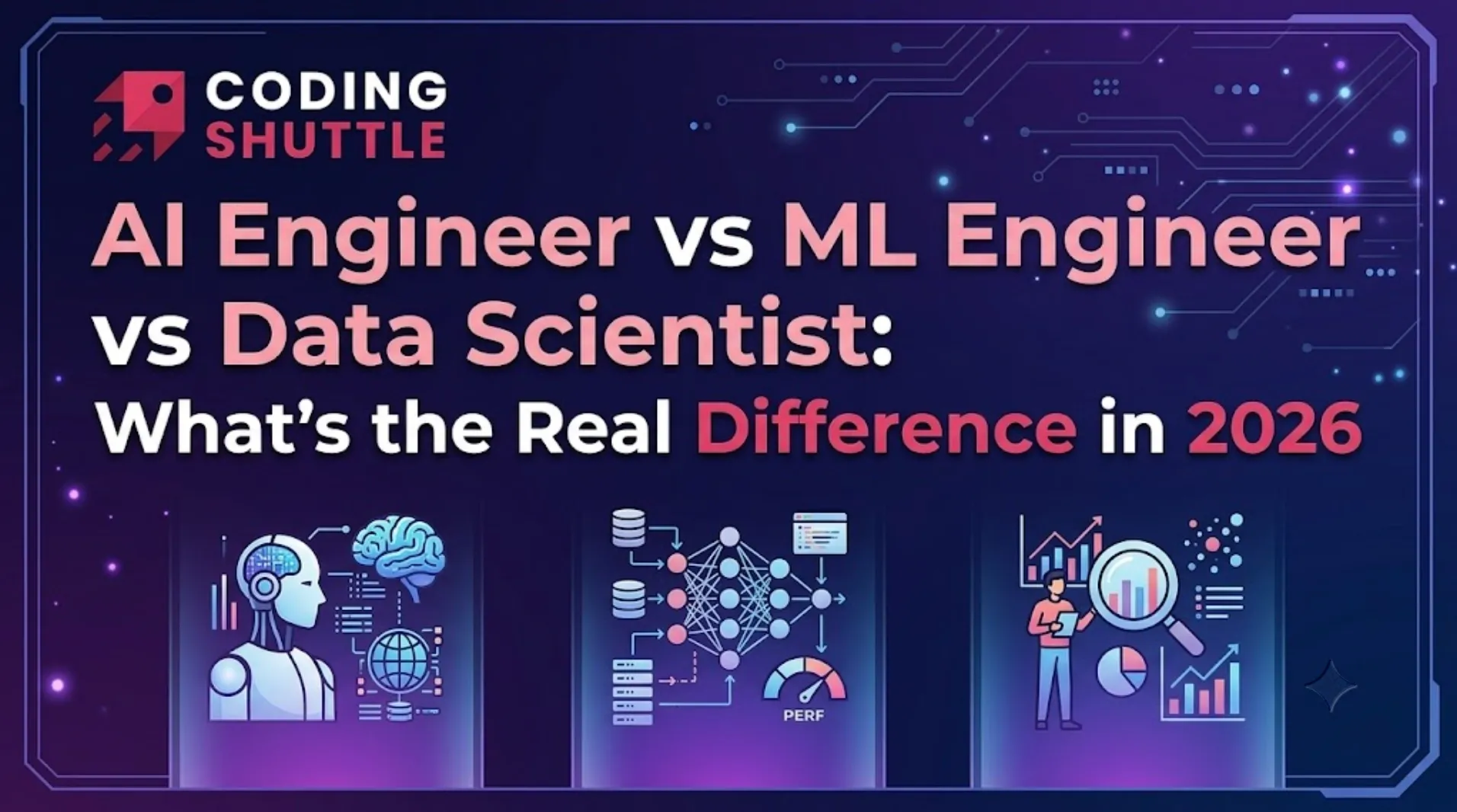
AI Engineer vs ML Engineer vs Data Scientist: What's the Real Difference in 2026
Data scientists, ML engineers, and AI engineers split along distinct deliverables: one owns a decision and its slide, one a reliable endpoint, and one product features built on foundation models. Each role implies different checkpoints, evaluation standards, and workflows. The article positions these career paths and the handoffs between them.

Shreyash Gurav
August 29, 2026
5 min read
AI Engineer vs ML Engineer vs Data Scientist: What's the Real Difference in 2026
Two job postings can carry the title "AI Engineer" and describe completely different jobs. One wants someone wiring GPT calls into a product. The other wants someone fine-tuning open models on proprietary data with a GPU cluster. Meanwhile "Data Scientist" at one company means SQL dashboards and at another means training recommendation models.
Titles are unreliable. Centers of gravity are not. Each of these three roles has one, and once you see it, you can classify any posting, team, or career move in about a minute.
Three Roles, Three Centers of Gravity#
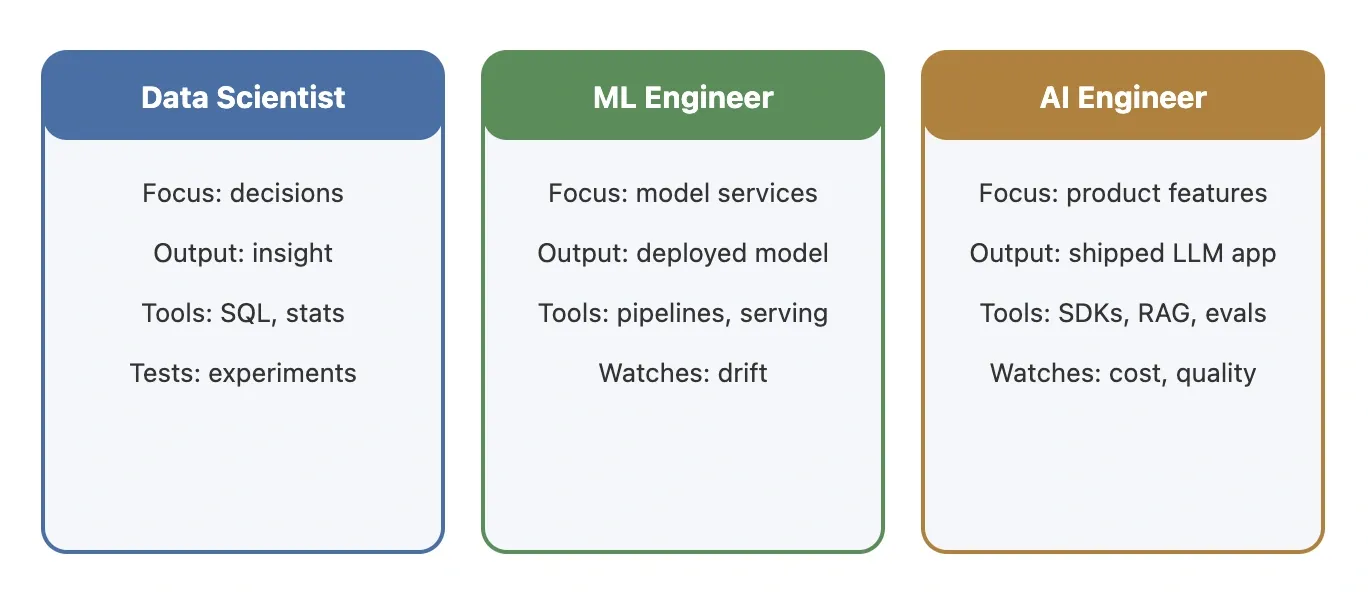
Data scientists convert questions into measurable answers. Their raw material is your company's historical data; their tools are SQL, statistics, experimentation, and visualization. They run A/B tests and argue about whether a metric moved for real or by noise. Models appear in their work sometimes, but the deliverable is usually a decision: launch this, price it that way, this segment is worth pursuing. If the output of the work is a slide that changes what the business does next, you are looking at data science.
ML engineers turn model behavior into reliable services. They build training pipelines, manage feature computation, deploy models behind APIs, monitor for drift when the world changes under a model trained yesterday, and own the retraining cadence. Their deliverable is an endpoint that meets latency and accuracy targets in production, month after month. This is software engineering with the added difficulty that the artifact being served is statistical rather than deterministic.
AI engineers build product features on top of foundation models. They compose pretrained LLMs with application code: prompts and output schemas, retrieval over private documents, tool calling, guardrails, evaluation harnesses. Their deliverable is something a user clicks. Of the three roles, this is closest to traditional software engineering; the difference is that a core dependency is probabilistic, metered per token, and occasionally hallucinates.
Same Feature, Three Jobs#
Nothing separates these roles faster than watching them attack one problem together. Say a support team wants incoming tickets auto-routed to billing, bugs, or how-to queues.
The data scientist goes first. How many tickets arrive daily? What is the historical distribution across categories? What misroute rate is tolerable before agents stop trusting the system? The analysis might reveal that two categories dominate and that a wrong billing route costs the most agent time. That shapes everything downstream, including whether automation is worth it at all.
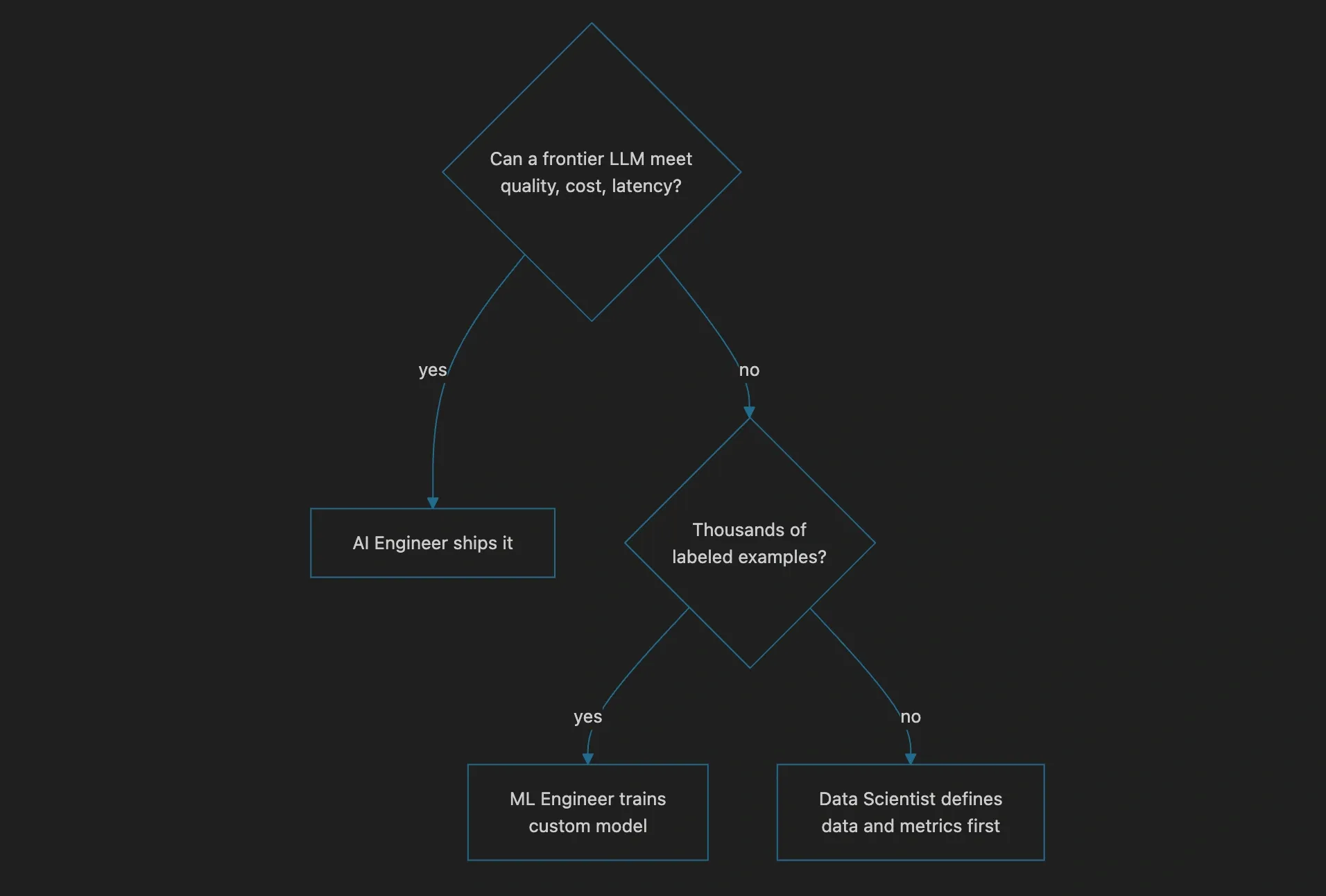
The AI engineer ships version one. A frontier LLM classifies each ticket into a strict JSON schema with an urgency score, wrapped in retries and logged with confidence flags. No training data required, working in days, quality measured against a hand-labeled eval set of fifty tickets. For most teams at moderate volume, this version simply wins and stays.
The ML engineer gets involved only if the economics break. At very high volume, per-call API costs add up, or privacy rules forbid sending tickets to external APIs. Then the play is distillation: use the LLM's outputs as training labels, fine-tune a small classifier, serve it cheaply on owned infrastructure, monitor drift as ticket language shifts. That is classic ML engineering territory, unlocked by AI-engineered bootstrapping.
Three specialists, one feature, no hierarchy. Sequencing matters more than org charts.
Questions Everyone Asks Anyway#
Who earns more? Across most organizations the bands overlap heavily, and premium follows shipped outcomes rather than titles. A data scientist who reliably finds revenue leaks and an AI engineer who ships a feature that cuts handling time in half are both negotiating from strength. Do not pick a role by survey medians; they lag reality by years.
Which is easiest to enter? Today, AI engineering has the lowest barrier because foundation models give you frontier capability without training data or GPUs. Data science usually expects genuine statistics depth up front. ML engineering usually expects production experience, which makes it awkward as a first role even though companies post junior reqs anyway.
Which survives the next five years? All three, but each converges on the same durable core: rigorous evaluation of probabilistic systems. The data scientist never stopped doing this. The other two are catching up.
Choosing Your Lane#
Some honest heuristics. If you light up debugging production systems and want models serving traffic you personally tuned, ML engineering fits. If ambiguity plus numbers feels like home and you want influence over business decisions, data science fits. If you want the shortest path from idea to something users touch, and you would rather compose intelligence than create it, AI engineering fits.
Mobility between lanes is real. AI engineers move toward ML engineering by adding fundamentals: scikit-learn, training loops, evaluation beyond prompts. ML engineers move toward AI engineering mostly by adding product instincts and modern tooling. Data science bridges through analytics engineering in either direction. Nobody is locked in.
Titles Blur, Skills Compound#
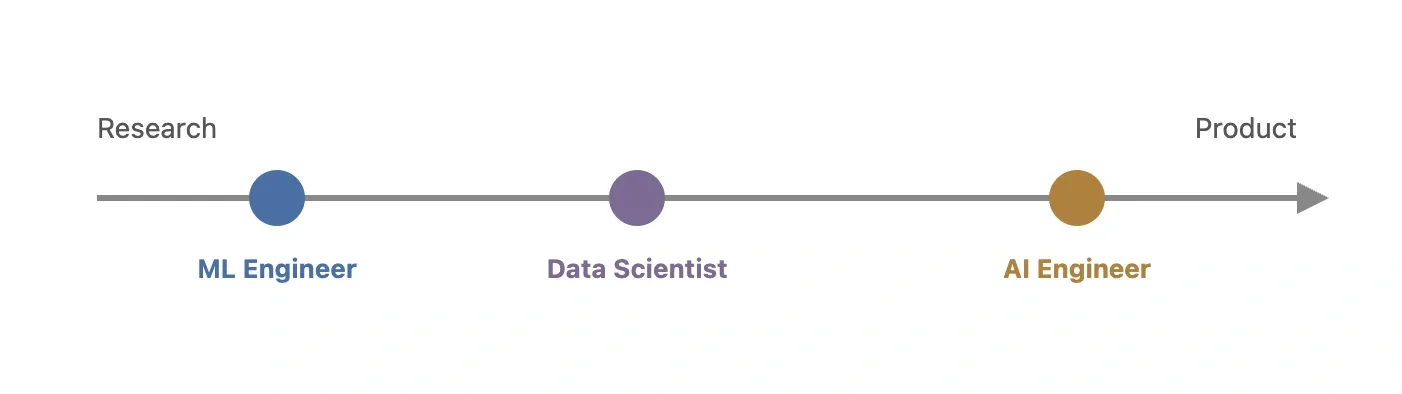
Treat these distinctions as coordinates, not borders. Companies will keep using the titles loosely, and the roles themselves keep drifting as models commoditize: work that required an ML engineer five years ago is an SDK call today, which is precisely why AI engineering exploded as a discipline.
What does not blur is the underlying skill set: judgment with data, discipline about evaluation, and plain software craftsmanship. Build those and the specific title becomes a formatting detail. Pick problems that interest you, ship outcomes, and let the titles chase you instead of the reverse.
Want to Master Spring Boot and Land Your Dream Job?
Struggling with coding interviews? Learn Data Structures & Algorithms (DSA) with our expert-led course. Build strong problem-solving skills, write optimized code, and crack top tech interviews with ease
Learn more